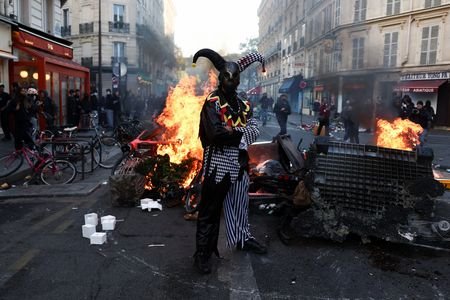
PARIS, Oct 19 (Reuters) - France saw some of the worst unrest in years at the weekend as huge protests across the country over the cost of living and underfunded public services descended into riots and looting.
Limoges town hall was torched and more than 3,000 shops were pillaged or damaged, according to the government, as violent groups clashed with police in cities across the country.
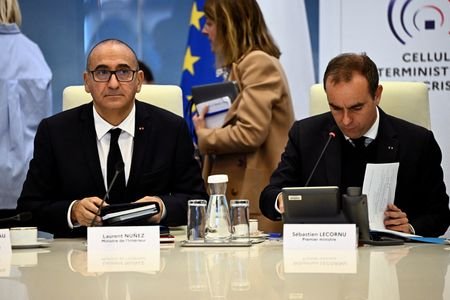
While mayors of France's biggest cities demanded answers from the government on Monday over what they say was a lack of preparation, authorities rushed to set up support measures for impacted businesses and bolster security as calm returned to the streets.
Here is the latest on the situation in France:
WHAT WILL THE GOVERNMENT DO TO QUELL THE VIOLENCE, COMPENSATE VICTIMS?
Some 2,400 people were arrested during the weekend and police investigators are poring over online videos and images to track down looters. Partial curfews are being organised in some municipalities while the government has said it will increase police numbers on the ground, especially for next weekend if it sees renewed protests. It has not specified how many extra officers will be made available.
For businesses and victims of the violence, the government is putting in place state-financed furlough measures to help employers avoid layoffs, and funds are being set aside to help companies meet their immediate cashflow needs. The government has yet to provide full details of the funding or how the money will be distributed. Insurers are also expected to cover some of the damage.
HOW WILL THE GOVERNMENT ADDRESS COMPLAINTS ABOUT THE COST OF LIVING AND PUBLIC SERVICES?
France's extremely strained public finances mean the government has precious little room for broader measures to address protesters' anger over the rising cost of living.
It has already hiked emergency spending this year to help certain sectors like farmers, fishermen and haulers cope with high fuel costs caused by the Iran war.
The protests in France began last month at high schools in Paris' working-class northern suburbs, where anger over teacher shortages and shabby facilities evolved into a broader movement.
The government has so far not committed to a substantial increase in funding for schools. However, it has pledged to send some 3,000 teachers, who are fully qualified but have not yet started work, to fill staffing gaps.
WILL PROTESTS ESCALATE OR HAVE THEY PEAKED?
Some protesters have already called for a new round of demonstrations on Saturday, October 24. Unions have called for strikes on November 5 to protest budget cuts and support hiking wages.
The weekend violence has largely eclipsed the recent high school student protests. Schools are now on a break for two weeks, but there have been reports of protests at some universities.
HOW WILL THE CRISIS AFFECT FRANCE'S DIRE ECONOMIC SITUATION?
The unrest will likely deal a blow to business confidence, which is already fragile due to a fiscal crisis and high energy prices resulting from the Iran war.
The minority government is struggling to pass spending cuts in France's deeply divided parliament as part of its 2027 budget and is at risk of being toppled by opposition parties if a compromise cannot be found with at least some of them.
The unrest has weighed on French stocks and the euro and put pressure on French government bonds, pushing the risk premium over the 10-year German benchmark up to 146 basis points, the highest in two weeks.
WILL THE UNREST SPREAD TO OTHER COUNTRIES?
If France cannot contain the unrest, there is a risk that it could spill across its borders. In neighbouring Italy, clashes erupted between police and protesters on Sunday during demonstrations over poor public services and the rising cost of living.
Albania has also seen a series of student demonstrations in recent days over corruption, a lack of jobs and poor education standards while Spain and Portugal have faced protests over housing.
HOW WILL THE UNREST AFFECT THE 2027 PRESIDENTIAL ELECTION?
Elections next year will see President Emmanuel Macron step down after a decade in power. The unrest is likely to give a boost to far-right presidential candidate Marine Le Pen, who is already the frontrunner in polls to replace him and has long talked tough on law and order.
"Le Pen no longer needs to spend any money to campaign," Jean-Baptiste Moreau, a former lawmaker from Macron's camp, told Reuters. "It's not just a clear path ahead of her, it's a six-lane highway."
Hard-left candidate Jean-Luc Melenchon has come under pressure for backing protesters' demands, criticising the government's handling and not clearly condemning the violence.
Meanwhile, Macron, who headed off to the Middle East on Monday, has emerged from the crisis further weakened. His former prime minister Edouard Philippe, now a centre-right presidential candidate, said on X he wanted "decisions and initiatives" from the lame-duck leader to "restore order".
ARE PARIS AND OTHER CITIES SAFE TO VISIT?
There have been no reports of any injuries to foreigners caught up in the unrest. However, several European governments advised citizens travelling to France to avoid large crowds and exercise caution.
(Reporting by Leigh Thomas; Editing by Peter Wilkinson and Joe Bavier)