By Andrew Osborn and Dmitry Antonov
MOSCOW, Oct 26 (Reuters) - Aleksandar Vucic's crushing election defeat by a student-backed protest movement has cast gloom over Moscow, which has lost another important partner in Europe just six months after ally Viktor Orban was ousted in an election in Hungary.
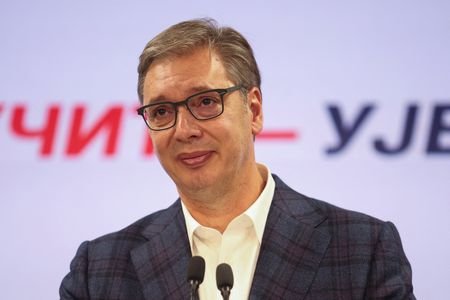
Serbia woke to a new era on Monday after Vucic, a frequent visitor to Moscow who had been prime minister or president since 2014, suffered a defeat on Sunday that prompted nationwide celebrations, although few had any idea of how the Balkan country's new student-backed leaders would govern.
Russia saw Vucic's Serbia as a crucial ally in Europe, and as a bulwark against what Moscow has cast as the European Union's aggressive attempts to contain and punish it over its war in Ukraine.
Serbia buys large quantities of gas from Russian energy giant Gazprom, and although it has aspirations to join the European Union, it has not signed up to EU-backed sanctions on Russia over Ukraine. Instead, under Vucic — who enjoyed close ties to President Vladimir Putin — it continued to develop close economic, political and military links to Moscow.
The Kremlin put a brave face on Vucic's defeat, saying it had taken note of the result and that Vucic — whose contribution to bilateral ties it warmly praised — was moving into opposition.
"As for the new political force that will come to power as a result of the elections, we wish to express our hope that its actions will also be constructively directed towards the further development of relations, and that these new political forces will understand that cooperation with Russia is in Serbia’s interests, because it benefits Serbia," Kremlin spokesman Dmitry Peskov said.
"For our part, we intend to continue to do everything we can to foster the development of our relations with Belgrade. But, as you know, it takes two to tango."
GEOPOLITICAL SETBACK
Russia can still count EU member Slovakia, under Prime Minister Robert Fico, as a friendly country. It has also been closely watching unrest in France, where far-right politician Marine Le Pen has said she would cut financial aid to Ukraine if she won next year's presidential election.
Recent regional electoral successes for the far-right Alternative for Germany (AfD) have been welcomed in Russia, where Putin's special envoy Kirill Dmitriev has begun to speak about the possibility of one day reopening the Nord Stream gas pipelines between Germany and Russia which were blown up in 2022.
But for now at least, the potential loss of Serbia as a close ally — after setbacks to Russia's geopolitical influence in the South Caucasus region and parts of Central Asia — is being seen as a serious blow in Moscow by Kremlin-aligned politicians, media and analysts.
Before Sunday's election, the Student List party said it would not introduce sanctions on Russia over Ukraine, that it would retain Serbia's military neutrality, and that it would not seek to join NATO.
Vucic has cast doubts on those pledges, suggesting the party would renege on them and impose sanctions on Moscow as soon as March or April.
Members of Russia's political elite fear Serbia's EU aspirations could see it coming under greater pressure to align itself more closely with EU foreign policy and that Moscow could find itself betrayed by a traditional ally in the process.
"Brussels, for its part, is keen to see Belgrade align itself more closely with the common European position on Russia. The main indicator of Serbia's actual course will not be Vucic's statements or his opponents’ electoral pledges, but rather the first decisions taken by the new cabinet," said the Moskovsky Komsomolets newspaper.
Fyodor Lukyanov, editor-in-chief of the influential Russia in Global Affairs journal, said it was clear that a new political era was under way in Serbia that could sharply reorient the country towards the EU, in the same way that Orban's loss of power in Hungary saw Budapest and Brussels become much closer.
"In this sense, the Hungarian case is quite telling," said Lukyanov. "And Russia has nothing good to look forward to."
(Reporting by Reuters Writing by Andrew Osborn Editing by Keith Weir)