By Sarah Morland
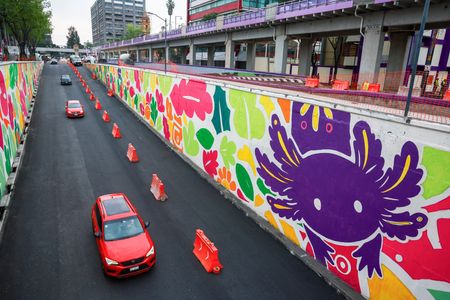
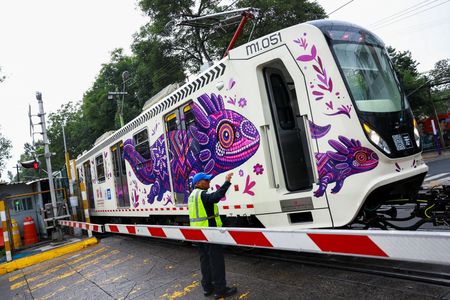
MEXICO CITY, June 8 (Reuters) - One of the first things visitors arriving in Mexico City for the World Cup are likely to see is the wide grin of an axolotl, with the salamander unique to this part of the world splashed in bright purple on murals and subway cars or depicted in sculptures dribbling a soccer ball.
Named after the Nahuatl word for "water monster," the axolotl (pronounced ah-sho-LO-tul) has become the unofficial mascot as the city gears up to host five World Cup matches, including the competition opener on Thursday.
But despite the undoubted cuteness of the almost otherworldly axolotl, the use of its image has drawn backlash from many Chilangos - as Mexico City residents are known - who say the poppy portrayal of the critically endangered animal is being used to distract from both the infrastructure problems of the capital and its lack of conservation efforts.
Scientists trying to count axolotls in the wild say they have not seen a single one in two years, and a campaign against what has been dubbed "axolotlization" has unleashed a wave of internet memes in which Godzilla-like axolotls rampage around the city.
The Mexico City government did not respond to requests for comment.
Ernesto Velazquez, 19, who runs an axolotl-themed stand selling cuddly toys in Chapultepec park, told Reuters he hopes the newly painted images around the city can drive more interest in conservation.
"Some foreigners have asked if you can eat them - well no, they're at risk of extinction," he said. "I hope the World Cup will help people learn more so we take better care of them."
A DISAPPEARING HABITAT
For centuries, Ambystoma mexicanum, an amphibian that remains living in water through its life cycle, thrived between chinampas - farms built on man-made floating islands that once sustained the Aztec capital of Tenochtitlan, where modern-day Mexico City lies.
The lake the city was built on was largely drained under colonial rule and its remnants are being used up and contaminated by the growing urban sprawl.
But the city's southern Xochimilco district - known for its maze of muddy canals whose spooky folklore and colorful barges attract boisterous boat parties - remains one of the axolotl's last hiding places.
UNAM, Mexico's top university, identified around 36 axolotls per square kilometer in Xochimilco in 2014 - a steep decline from 6,000 per square kilometer in 1998. The latest census began in 2024, and, two years later, researchers have yet to find a single axolotl.
Vania Mendoza, who coordinated the census, said she and a small team would set out onto the canals on barges before dawn throughout the winter to try to count axolotls in their nets.
They did not find any, but by analyzing the water for DNA, they were able to confirm that some axolotls survive in the canals. UNAM is preparing to publish its results by late summer.
"We know they're there," Mendoza said.
SOCCER AND MASS TOURISM
Luis Zambrano, who heads UNAM's ecological restoration laboratory, said that besides a constant flow of poorly treated wastewater, fresh dangers to the axolotl include chinampas being turned into soccer pitches and the overcrowding of what began as ecological tourism.
Axolotls consume oxygen through their skin, making them highly vulnerable to water pollution.
"Mass tourism has become a terrible problem now with the World Cup," said Zambrano. "The government thinks more is better, but that's not true in these areas of high ecological value."
Even as their habitat disappears, axolotls are widely bred in captivity. Scientists believe their unique skin mucus and ability to regrow limbs and even parts of their brain offer promising leads in cancer research.
Andres Huerta, 28, a pharmacist from Phoenix, Arizona, visiting during the World Cup, told Reuters he knew little about axolotls before arriving, but was impressed by a large mural he saw after landing at the airport.
"It's really beautiful," he said.
Outside the Azteca stadium, where the opening match will be held, a football-themed axolotl statue named 'Ajologol' was removed last month. Mayor Clara Brugada told reporters too many people had been taking photos and blocking the way in, but that Ajologol would soon be resettled nearby.
For UNAM ecologist Zambrano, the axolotls' viral popularity has yet to translate into concrete action that could save their home. "People prefer to see them in fish tanks," he said.
($1 = 17.3244 Mexican pesos)
(Reporting by Sarah Morland; editing by Stephen Eisenhammer and Rosalba O'Brien)