BEIRUT, June 9 (Reuters) - Israel struck the historic port city of Tyre in southern Lebanon on Tuesday killing at least eight people, the Lebanese health ministry said, and minutes later ordered the evacuation of the entire city for the first time.
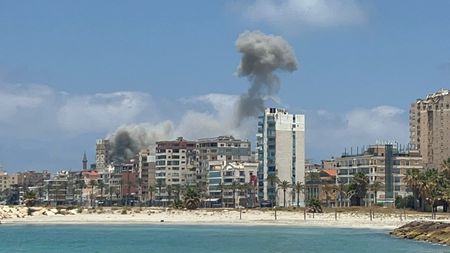
The deaths followed a single strike on the city's eastern edge, the ministry and state media said, in one of the deadliest Israeli bombing raids on Tyre since fighting with the Lebanese armed group Hezbollah erupted on March 2.
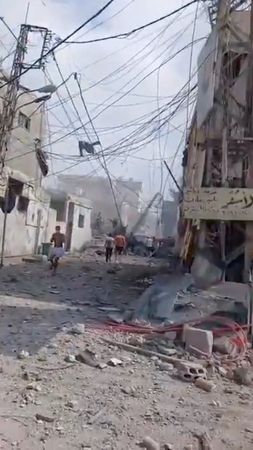
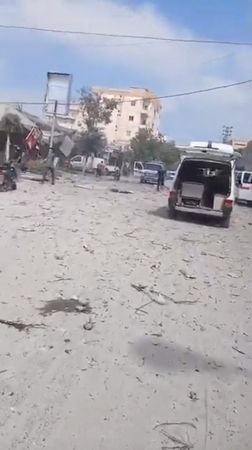
A video of the aftermath, in a location verified by Reuters as being in the neighborhood of the strike, showed debris strewn across the length of a road. In a smoke-filled alleyway, a crane could be seen operating near a damaged building.
The health ministry said rescuers were still searching through the rubble of the strike for survivors.
'WE'RE TIRED,' HOSPITAL DIRECTOR IN TYRE SAYS
The strike, which hit an area known as al-Masaken al-Shaabiyah, was first reported by Lebanon's state media agency at 9:22 a.m. local time (0622 GMT).
Israel issued an evacuation warning for the entire city of Tyre, including its northwestern Christian quarter, at 9:31 a.m. local time (0631 GMT) through an online warning on X by an Israeli military spokesperson.
An Israeli military spokesperson said the strike had targeted "terror infrastructure in the area” but did not respond to a question from Reuters about why the strike took place before the evacuation warning. The military's most recent evacuation warning for other parts of Tyre was published on June 7.
For some strikes, Israel's military issues localized evacuation warnings for areas around specific buildings that it will target. In other cases, it issues evacuation warnings for entire swathes of territory without specifying where or when strikes may take place, or carries out strikes without evacuation warnings.
People displaced from elsewhere in Tyre had been seeking shelter in the Christian quarter, which had been left out of previous evacuation orders.
Last week, the Israeli military said militants from Iran-backed Hezbollah were hiding out in the area, without providing evidence. It urged Christians in the city to demand Hezbollah depart, and threatened to order the district's evacuation if the fighters did not leave.
Lebanese Social Affairs Minister Haneen Sayed told Reuters that parts of Tyre "had become one of the last relatively accessible places where they could find shelter, stay with relatives, or access basic services."
Sayed said the evacuation order raised serious concerns about humanitarian access and could make it harder for aid organizations to reach those in need as people fled.
Wael Mroue, the director of the Jabal Amel hospital inside Tyre, said there were noticeably fewer wounded arriving at the hospital because so many people had fled the city.
He said at least a dozen wounded including women arrived after the strike on al-Masaken al-Shaabiyah.
"We're tired. We're scared. But we are staying," he told Reuters, saying hospital staff and their families were all living at the hospital due to the intensity of strikes nearby.
MSF SUSPENDS OPERATIONS
Doctors Without Borders (MSF) said in a statement it was deeply concerned by what it called "forced displacement practices," referring to Israel's warning for people to leave before the strikes.
It said they "expose people to further harm by compelling them to move in unsafe and chaotic conditions."
MSF said it had to suspend its medical activities at several hospitals nearby, as well as its mobile clinic operations, for the day.
The latest war in Lebanon erupted when Hezbollah launched rockets at Israel in support of its ally Tehran. Israel has retaliated with heavy strikes and a ground invasion that has occupied swathes of the south.
The U.S. announced a ceasefire on April 16, but it has failed to halt fighting in southern Lebanon.
Israel has continued to issue evacuation orders for southern Lebanon that have effectively emptied a fifth of the country, including areas far beyond the front lines.
(Reporting by Maya Gebeily, Edward Carron in London, Ahmed Elimam in Dubai; Additional reporting by Rami Ayyub; Editing by Kirsten Donovan, Aidan Lewis and Sanjeev Miglani)