By Maayan Lubell, Laila Bassam and Maya Gebeily
JERUSALEM/BEIRUT, April 15 (Reuters) - Israel's security cabinet convened on Wednesday to discuss a possible Lebanon ceasefire, a senior Israeli official said, more than six weeks into a war with Hezbollah that spiralled out of the U.S.-Israeli conflict with Iran.
U.S. President Donald Trump earlier said the war with Iran could end soon, telling the world to watch out for an "amazing two days".
Israeli Prime Minister Benjamin Netanyahu's government was under heavy pressure from Washington to reach a ceasefire in Lebanon, another senior Israeli official said.
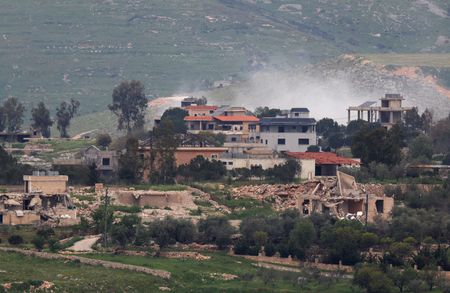
While the security cabinet was meeting, however, Netanyahu released a video statement in which he said the Israeli military continued to strike at Hezbollah and was about to "overcome" the southern Lebanese town of Bint Jbeil.
Hezbollah fighters are holed up inside Bint Jbeil, a stronghold of the group and a gateway to surrounding villages.
Netanyahu said he had instructed the military to continue reinforcing the security zone in southern Lebanon while at the same time negotiating a peace deal with Lebanon.
Israel and Lebanon held rare talks between government envoys in Washington on Tuesday.
"These negotiations have not taken place for over 40 years. They are happening now because we are very strong, and countries are coming to us - not only Lebanon," Netanyahu said.
ISRAEL SETS HEZBOLLAH 'NO-GO ZONE'
Israel's offensive in Lebanon began on March 2 after the Iran-backed Hezbollah opened fire at Israel in support of Tehran, reigniting war between the foes just 15 months after their last major conflict.
The war has killed more than 2,000 people in Lebanon and forced 1.2 million from their homes, Lebanese authorities say.
The Israeli military has sent troops into the south, where it has vowed to establish a buffer zone and maintain control over territory all the way to the Litani River, which meets the Mediterranean about 30 km (20 miles) north of Israel's border.
"I have instructed that the entire area of southern Lebanon up to the Litani River become a no-go zone for Hezbollah operatives," the Israeli military's chief of staff, Eyal Zamir, said during a visit to southern Lebanon.
Hezbollah attacks have killed two Israeli civilians, while 13 soldiers have died in Lebanon since March 2, Israel says.
WASHINGTON TALKS
Two senior Lebanese officials said they had been briefed that efforts were under way for a ceasefire. One of them said the U.S. had been pressuring Israel to work towards a ceasefire in Lebanon, including during the talks between the Israeli and Lebanese government envoys in Washington.
The two officials did not have details on when any ceasefire would begin or how long it would last. They said the duration would likely be linked to how long a truce between the United States and Iran holds.
Trump has urged Israel to scale back attacks in Lebanon, apparently to avoid undermining the ceasefire with Iran.
The Trump administration had not asked for a ceasefire, but the U.S. president "would welcome the end of hostilities in Lebanon as part of a peace agreement between Israel and Lebanon", a senior administration official said.
Iran has said Lebanon must be included in any agreement to end the wider war in the Middle East. Washington has pushed back, saying there is no link between the two sets of talks.
Hezbollah's decision to open fire on March 2 sharply worsened longstanding tensions in Lebanon over its status as an armed group. The Lebanese government, which has been seeking Hezbollah's peaceful disarmament since a war with Israel in 2024, banned the group's military wing on March 2.
Senior Hezbollah lawmaker Hassan Fadlallah condemned the government's decision to hold talks with Israel. In a televised news conference, he said the government had "taken a wrong path that leads only to increasing the rift" among Lebanese.
HEZBOLLAH LAUNCHES ROCKET ATTACKS
The Israeli military, which has previously ordered residents to leave swathes of the south, reiterated instructions for them to move north of the Zahrani River, saying in a post on X that it was operating with "great force" in the area. Israel last ordered residents to move north of the Zahrani on April 8.
The Zahrani runs north of the Litani.
Hezbollah announced new rocket attacks.
An Israeli government spokesperson said the group fired 40 rockets into Israel on Wednesday morning.
Israel has not carried out airstrikes on the Beirut area since April 8, when it launched its heaviest attacks yet.
The Lebanese health ministry says those attacks killed 357 people, including 71 women and 30 children. Israel has said the strikes killed more than 250 Hezbollah militants.
(Reporting by Jana Choukeir and Tala Ramadan in Dubai; Steven Scheer and Rami Ayyub in Jerusalem; Alexander Cornwell in Tel Aviv Writing by Tom Perry; Editing by Janane Venkatraman, Alison Williams, Toby Chopra, Rod Nickel)