
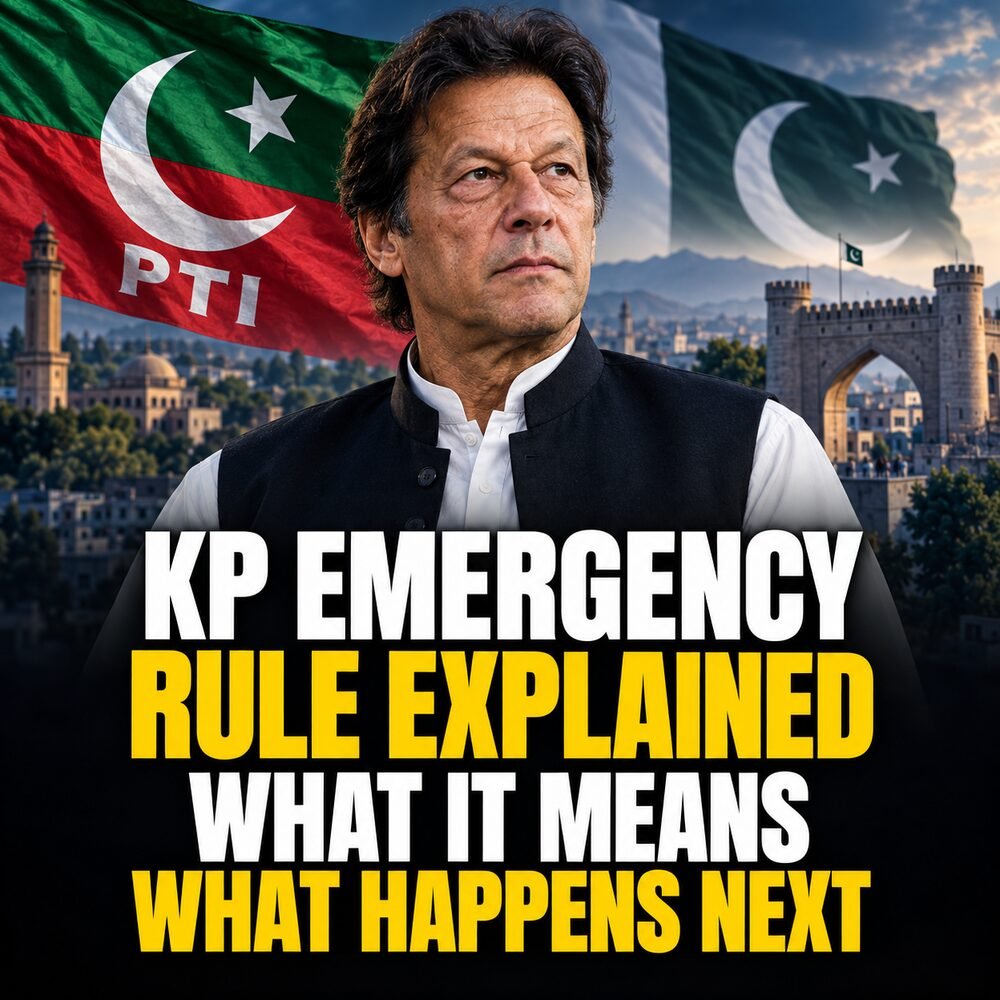
Pakistan’s emergency measures have shifted power away from the provincial administration led by Pakistan Tehreek-e-Insaf, Imran Khan’s party. Parliamentary approval has followed, while legal challenges put the constitutional basis and limits of the intervention under scrutiny.
Pakistan’s decision to impose emergency measures and governor’s rule in Khyber Pakhtunkhwa has become a dispute over security, provincial autonomy and the limits of federal authority. The proclamations were issued on 11 October, and a joint sitting of Parliament approved both measures on 15 October, according to Radio Pakistan.
For residents, the immediate issue is who makes decisions about provincial administration. For the wider country, the question is whether exceptional constitutional powers were justified and properly used. Parliamentary approval is an important procedural step, but the challenges reported in court show that the legality of the intervention remains contested.
Why the federal government intervened
The federal government says deteriorating security and inadequate cooperation from the provincial leadership made intervention necessary. In Parliament, Law Minister Azam Nazeer Tarar described the action as a last resort, while Interior Minister Mohsin Naqvi said attempts to secure a joint counterterrorism approach had failed. These are the government’s stated reasons for the decision.
Al Jazeera reported PTI’s rejection of the measures as a disguised coup. The central disagreement is therefore about both the security response and whether the circumstances justified displacing elected provincial authority.
Emergency powers and governor’s rule are different
The two measures were announced together, but rely on different constitutional provisions. Article 232 concerns a grave emergency threatening Pakistan, or part of it, through war, external aggression or an internal disturbance beyond a provincial government’s control. It allows a wider federal role in provincial affairs, including directions to the province and legislation on matters normally outside Parliament’s federal remit.
Article 234 addresses a failure of constitutional machinery in a province. It allows provincial executive functions to be assumed by the president or exercised through the governor on the president’s behalf. It also permits provincial assembly powers to be exercised by, or under the authority of, Parliament. That is the constitutional mechanism commonly described as governor’s rule.
The practical effect is to remove the elected provincial administration from its usual position of executive control. It does not mean that every provincial institution stops operating. Article 234 also expressly protects the powers and constitutional position of the High Court from being taken over under that provision.
Why the approval process is being challenged
Article 232 contains safeguards concerning a provincial assembly resolution for an emergency based on internal disturbances. It also provides for approval by each house of Parliament within ten days when the president acts on his own. How those requirements apply to the October intervention is a legal question; later parliamentary endorsement should not be presented as a court ruling settling it.
The News reported on 21 October that lawyer Muhammad Yousaf Javed had challenged the measures in the Federal Constitutional Court. His petition argues that a breakdown of constitutional machinery had not been demonstrated and seeks to have the proclamation declared unlawful. Those assertions are the petitioner’s case, rather than findings by the court.
Dawn reported that challenges at the Peshawar High Court were adjourned until 10 November.
How long can governor’s rule last
Article 234 says a proclamation expires after two months unless approved by a joint sitting. Further extensions may be approved for periods of no more than two months at a time, subject to a total maximum of six months. The six-month ceiling should therefore not be confused with an unconditional, automatic six-month term.
What happens next
The next developments to watch are court orders, the terms of any parliamentary extension and decisions made by the administration exercising provincial powers. An announced hearing date does not guarantee a final judgment that day, and filing a petition does not itself suspend a government measure.
The dispute will also be judged against the purpose the federal government has given for intervening: improving security. Restoring accountable provincial government, addressing the legal challenges and demonstrating progress against violence remain distinct tests. A declaration of emergency, by itself, does not resolve any of them.
Sources and references
[1] Radio Pakistan — parliamentary approval, 15 October 2026
[2] The News — Federal Constitutional Court petition, 21 October 2026
[3] Al Jazeera — emergency report, 11 October 2026
[4] Constitution of Pakistan — Article 232
[5] Constitution of Pakistan — Article 234
[6] Dawn — court update, 20 October 2026