
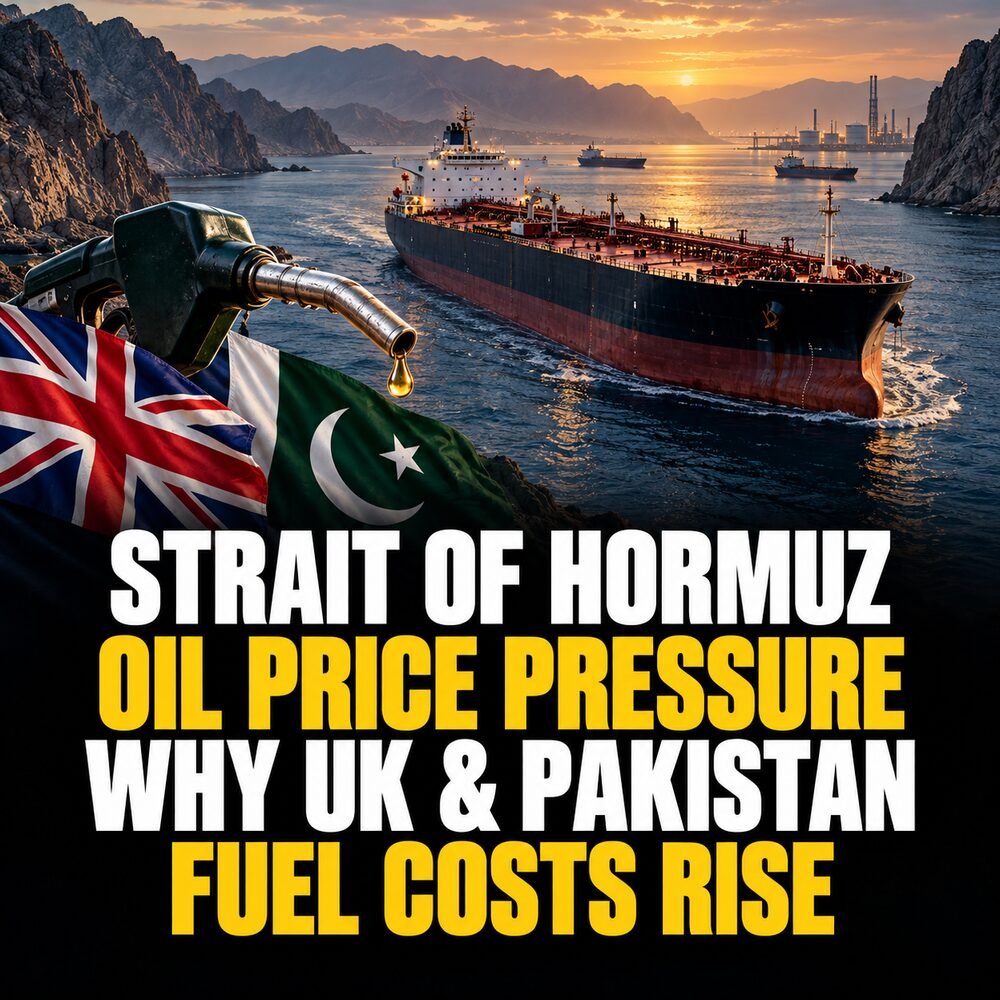
Attacks and uncertainty around a vital Gulf shipping route are putting pressure on oil markets. The effects reach British and Pakistani consumers through wholesale fuel costs, exchange rates and domestic pricing decisions.
Fresh concerns about Middle Eastern oil supplies have pushed crude prices higher again, extending pressure on households and businesses. Reuters reported Brent futures at $115.36 a barrel at 01:40 GMT on 28 October, up $1.48. The increase followed a Houthi claim of a missile strike on a Saudi refinery, which Saudi authorities had not immediately confirmed.
That is a later market snapshot than the $110 level reached on 16 October, when Reuters reported escalating attacks around the Strait of Hormuz alongside concerns about Russian supplies. Neither figure is a permanent price or a direct quotation for petrol at the pump.
Why this narrow waterway matters
The Strait of Hormuz connects the Persian Gulf with the Gulf of Oman and the Arabian Sea, between Iran and the Arabian Peninsula. It is only about 39 kilometres wide at its narrowest point. The International Energy Agency says roughly 20 million barrels of crude oil and petroleum products passed through it each day in 2025, representing about a quarter of global seaborne oil trade.
Those are historical traffic figures, rather than a measurement of current shipments during the conflict. They show the scale of the route’s importance: a disruption can affect buyers well beyond the countries that receive tankers directly from Gulf ports.
Why prices can rise before a complete closure
Oil markets respond to the possibility of future shortages as well as barrels already lost. In market terms, a higher price can include a risk premium: buyers are paying more because reliable delivery has become less certain. This helps explain why attacks or threats can move prices without a complete closure of the strait. [4]
Reuters also reported a fall of nearly $2 on 27 October as regional talks eased supply concerns. News about diplomacy and attacks can pull prices in opposite directions.
How the shock reaches UK forecourts
British drivers are exposed to international prices even when the fuel they buy has not travelled through Hormuz. Crude oil and refined products trade in connected global markets, so a threat to Gulf supplies can raise the price of alternatives elsewhere.
The RAC identifies crude prices, refining costs, distribution, retailer margins and the pound’s value against the dollar as key influences on UK fuel costs. A weaker pound makes dollar-priced oil and wholesale fuel more expensive for British buyers. Duty and VAT also form part of the final bill.
Changes do not necessarily appear at every forecourt immediately. The RAC describes a typical lag of about two weeks between wholesale movements and pump-price adjustments as fuel moves through the supply chain. The timing and size of a change can differ between retailers.
Why Pakistan is exposed too
For Pakistan, international prices and the rupee’s exchange rate can work together. A higher dollar cost for fuel becomes more expensive in rupees; if the rupee weakens at the same time, the local-currency pressure increases. The State Bank of Pakistan has documented both international crude prices and currency depreciation as contributors to domestic petrol-price movements.
Retail pricing also includes domestic policy choices and distribution costs. Government levies, duties and industry margins mean that a percentage change in Brent does not translate mechanically into the same percentage change in petrol or diesel. OGRA’s published price notifications are the appropriate reference for officially notified rates; a crude futures quotation is not a substitute.
The impact extends beyond private cars. As an economic consequence, more expensive diesel can put pressure on haulage, deliveries and farming costs. Whether businesses pass those increases to customers depends on competition, contracts and their ability to absorb costs.
Can other routes bring relief
Saudi Arabia and the UAE have pipelines that can bypass Hormuz, but the IEA estimates only about 3.5 million to 5.5 million barrels a day of available alternative capacity in its February 2026 factsheet. Those routes cannot readily replace all the oil normally shipped through the strait.
For consumers, the developments that matter most are safer shipping, reliable production and sustained falls in wholesale prices. Exchange rates and domestic pricing decisions will still shape the final bill. Even if diplomatic progress lowers Brent, cheaper fuel may take time to reach the pump.
Sources and references
[1] Reuters via Business Recorder — oil market update, 28 October 2026
[2] Reuters — Brent touches 110 dollars, 16 October 2026
[3] International Energy Agency — Strait of Hormuz factsheet, February 2026
[4] UK Competition and Markets Authority — Road fuel review, 2022
[5] RAC — What affects the price of UK fuel, 23 January 2026
[6] State Bank of Pakistan — Annual Report FY23, chapter on inflation
[7] OGRA — notified petroleum prices