By Dmitry Antonov and Gram Slattery
MOSCOW, May 12 (Reuters) - The Kremlin repeated Russian President Vladimir Putin's assertion that the war in Ukraine was almost over on Tuesday and U.S. President Donald Trump said the war's conclusion was "very close," perspectives not shared by Ukrainian President Volodymyr Zelenskiy, who said Moscow had no intention of ending it.
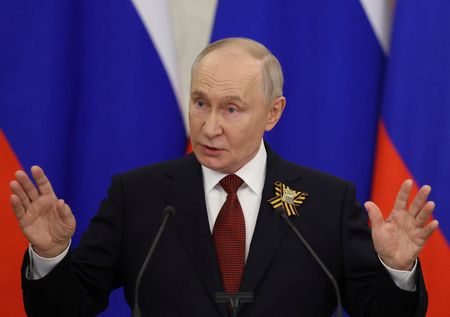
"I think that the matter is coming to an end," Putin told reporters on Saturday.
Asked to comment on Putin's remarks, Kremlin spokesman Dmitry Peskov said on Tuesday that a certain amount of trilateral work with Ukraine and the United States had been done towards winding down the war, now in its fifth year.
"This accumulated groundwork in terms of the peace process allows us to say that the completion is indeed approaching," Peskov told reporters, though he added it was difficult to provide specific details at the current time.
Speaking to journalists before departing on a state visit to China on Tuesday, Trump similarly said a settlement between the two nations was approaching, but he also did not elaborate.
"The end of the war in Ukraine I really think it's getting very close," Trump said as he left the White House.
Zelenskiy does not share that optimism. On Monday, he said: "Russia has no intention of ending this war. And we are, unfortunately, preparing for new attacks."
Trump has convened multiple rounds of talks with the warring sides to try to end the conflict, but no peace deal has emerged. Russia, which now occupies around a fifth of Ukraine, wants Kyiv to cede additional territory. Kyiv wants Russian troops to withdraw.
Peskov said Russia would welcome further U.S. mediation efforts and Putin was prepared to meet Zelenskiy in person once the peace process was finalised.
"And for that finalisation, in order to put a full stop to it, a great deal of preparatory work still needs to be done," he said, adding that the conflict could end as soon as Kyiv and Zelenskiy "take the necessary decision".
The warring sides agreed to a short, U.S.-mediated ceasefire from May 9-11, coinciding with the anniversary of the Soviet victory over the Nazis in World War Two.
Although neither side reported large-scale airstrikes during the ceasefire, both said fighting continued along the front line and accused each other of drone and artillery attacks.
(Reporting by Dmitry Antonov in Moscow and Gram Slattery in Washington; Writing by Maxim Rodionov and Alessandra Prentice; Editing by Guy Faulconbridge, Peter Graff and Daniel Wallis)