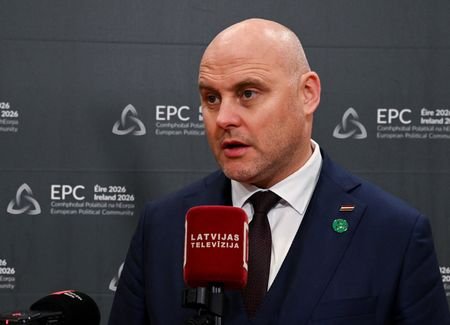
By Janis Laizans and Nerijus Adomaitis
RIGA, Nov 17 (Reuters) - Latvia's parliament on Tuesday gave a green light for Prime Minister Andris Kulbergs' new government coalition to take office, supporting his pledge to boost private-sector growth and reduce the number of government employees.
Kulbergs' centrist, pro-Ukraine United List won 35.3% of the votes in last month's parliamentary election, the most for any group since Latvia regained its independence in 1991, and is forming a government with the nationalist National Alliance.
The cabinet, which contains a mix of political appointees and technocrats, has the backing of 51 seats in the 100-seat chamber.
A businessman and amateur rally driver, Kulbergs came to power in May after the previous coalition crumbled over its handling of incidents in which stray Ukrainian military drones flew undetected into the EU and NATO member country's airspace.
Latvia's economy has lagged those of its Baltic neighbours for more than a decade, and Kulbergs pledged to spur growth, curb public spending and improve the efficiency of public administration.
"We've neglected economic issues, and that's where we need to place our emphasis. We need to attract investment," Kulbergs told a press conference in Riga.
He pledged to maintain defence spending at 5% of GDP, and to bolster national security.
Speakers in parliament were flanked by a Latvian and a Ukrainian flag, reflecting the government's pledge to continue its support for Kyiv and a hard line toward Moscow.
Career diplomat Girts Jaunzems, a former ambassador to Uzbekistan, will become foreign minister, replacing Baiba Braze, whose New Unity party is leaving the government.
Although pro-Russian parties in the election increased their representation in parliament, they remain sidelined and are unlikely to influence government policy, analysts have said.
No Latvian government has survived a full term, and Kulbergs will face an uphill battle holding together the United List, a loose alliance of small parties and independents.
(Reporting by Janis Laizans and Andrius Sytas, Writing by Louise Rasmussen; Editing by Kate Mayberry, Terje Solsvik and Anna Ringstrom )