By John Irish and Dominique Vidalon
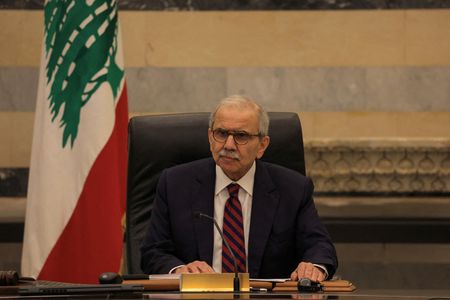
PARIS, April 21 (Reuters) - Lebanon's Prime Minister Nawaf Salam said on Tuesday his government was not seeking confrontation with Iran-backed Hezbollah, but would not allow itself to be intimidated as it prepares direct talks with Israel to end the conflict.
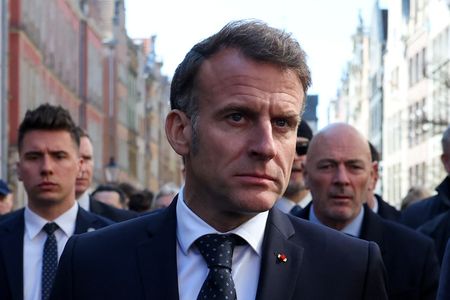
Salam and French President Emmanuel Macron met in Paris to see how to strengthen Lebanon's hand in possible direct future negotiations with Israel, as Beirut turns to a trusted European ally.
The U.S. will host ambassador-level talks with Israel and Lebanon on Thursday, although it remains unclear whether the objective is to extend a fragile 10-day ceasefire between Israel and Hezbollah or pave the way for deeper negotiations.
'NOT INTIMIDATED BY HEZBOLLAH'
"We are continuing along this path, convinced that diplomacy is not a sign of weakness, but a responsible act to leave no avenue unexplored in restoring my country's sovereignty and protecting its people," Salam said.
Israeli troops occupy territory deep in the south, aiming to create a buffer zone to shield northern Israel from Hezbollah attack, while the group says it maintains the "right to resist" Israeli occupation.
Lebanon in 2025 said it would disarm Hezbollah but its army treaded carefully, wary of igniting internal tensions. The United States and Israel criticised Lebanon for not moving fast enough.
"We are not seeking confrontation with Hezbollah. On the contrary, I wanted to avoid confrontation with Hezbollah, but believe me, we will not be intimidated by Hezbollah," Salam said when asked about the state's ability to disarm the group.
Salam said the country would need 500 million euros ($587 million) over the next six months to deal with the humanitarian crisis that has seen 1.2 million people displaced from Lebanon's south, east and the southern suburbs of Beirut.
FRANCO-LEBANESE HISTORICAL TIES
France, which has deep historical ties with Lebanon, has sought alongside Washington to mediate in the conflict, brokering the ceasefire in 2024 and helping establish a mechanism to monitor it.
But relations with Israel have soured over France’s stance on Gaza and the West Bank, its accusations that Israel’s actions in Lebanon are disproportionate, and its contacts with Hezbollah’s political wing.
Israel’s ambassador to Washington said last week that France should be excluded from any talks, describing Paris as having "no positive influence."
The U.S., while maintaining contact with France on the issue, has also sought to marginalise its role.
European and Lebanese diplomats say they fear that if direct negotiations begin, Lebanon’s government could be too weak to resist unrealistic demands, potentially fuelling domestic tensions given Hezbollah’s refusal to negotiate with Israel.
"We are trying our best to get them [France] back in the discussions, but the U.S. and Israel are adamant not to include them," said a Lebanese diplomat.
France has pushed initiatives only to be rebuffed by the U.S. and Israel.
Macron said the priority was to end the war and ensure stability for the future, promising to help Lebanese authorities prepare negotiations.
"France does not need to be at any negotiating table, wherever it may be, in order to stand by Lebanon," he said.
Echoing the need for French support, Salam said negotiations with Israel would be demanding, and as a result, Lebanon would need the "active" support of all its partners.
Paris argues that unlike Washington it has a significant presence on the ground in Lebanon with some 700 UN peacekeepers, and that any peace deal would still need a significant international presence to implement it.
A French soldier was killed in southern Lebanon this week in an attack the French government said was carried out by Hezbollah.
In a sign of the ceasefire's fragility, Israeli troops have continued demolitions of homes in the southern Lebanese border strip they now occupy and the Israeli military said Hezbollah had fired rockets at Israeli troops in that zone on Tuesday. There was no immediate comment from Hezbollah.
($1 = 0.8515 euros)
(Editing by Maya Gebeily, Alexandra Hudson, Rod Nickel)