By John Irish
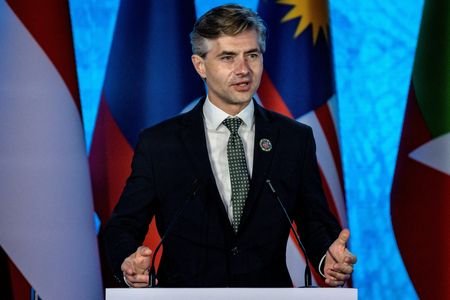
UNITED NATIONS, Sept 21 (Reuters) - The European Union has no reason to ease sanctions on Belarus, Lithuania's foreign minister said on Monday, arguing that President Alexander Lukashenko's government continues to repress opponents, violate human rights and back Russia's war in Ukraine.
US President Donald Trump said earlier in the day that Washington was working on a deal to purchase potash from Belarus, a key sector sanctioned by the EU.
The comments came a week after his administration negotiated the release of political prisoners in Belarus in return for some sanctions lifting, the latest in a year of talks between the two sides.
The US diplomacy is sensitive because Lukashenko, in charge of the former Soviet state since 1994, has long been shunned by the West for repressing his opponents and supporting Russia's war in Ukraine.
"Of course we would prefer to coordinate on sanctions policy as it is the most effective way to do this, but EU sanctions policy is a bit different," Kęstutis Budrys told Reuters in an interview at the UN General Assembly. "We do not see any reasons why our position on Belarus should soften as Belarus is not changing its behaviour."
The comments underscore a growing transatlantic divergence in approach toward Belarus.
While Budrys welcomed the release of prisoners, of which he said there remained about 1,000, and Vilnius would continue to provide assistance when they were freed, he said the EU should continue applying pressure on both the Belarusian and Russian governments, arguing that sanctions remained effective.
"We see how Lukashenko tries to find ways to get rid of them, and it means that we have to continue," he said.
"On our side, we have to be very exact and continue what works, and that is the pressure on the regime," he said.
The minister, whose country borders Belarus, said Minsk continued to pose a security challenge to the bloc, accusing it of orchestrating hybrid attacks against EU member states.
He cited what he described as the weaponisation of migration flows, particularly affecting Lithuania, Poland and Latvia, as well as smuggling operations, balloon incursions and other activities aimed at undermining European security.
"They are one of the major sources of hybrid activities against the European Union," he said.
The EU's current sanctions framework on Belarus remains in force until February 2027.
(Reporting by John Irish; Editing by Alistair Bell)