By Joshua McElwee, Cassandra Garrison and Marco Aquino
LUJAN, Argentina, Nov 11 (Reuters) - Pope Leo wrapped up his visit to Argentina on Wednesday with a final event drawing 2 million people, before continuing on his 12-day South America tour with a visit to Peru in an emotional homecoming for the first Peruvian citizen to lead the Catholic Church.
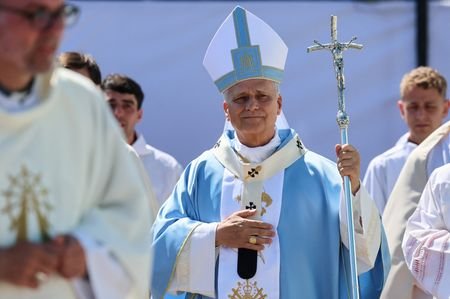
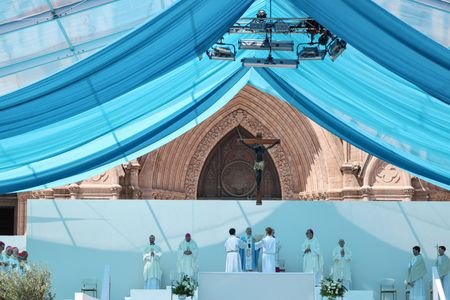
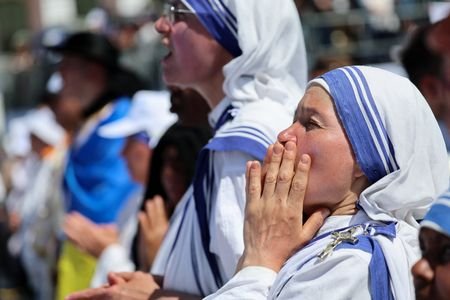
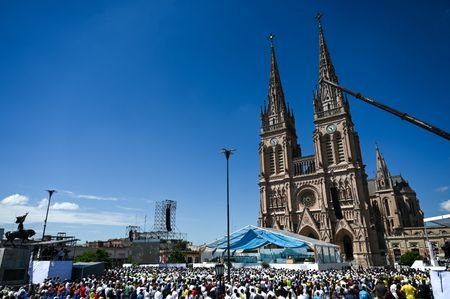
Leo, on a three-nation tour through November 17, celebrated an outdoor Mass at the shrine of Our Lady of Lujan, Argentina's most important Catholic devotional site, where throngs of pilgrims gathered for days in advance for a chance to see him.
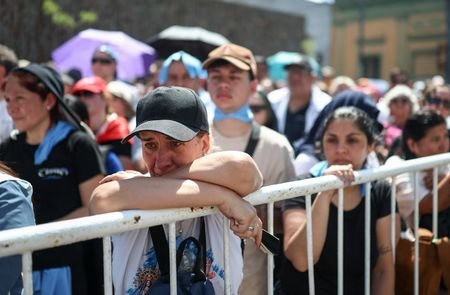
Crowds stretched for miles outside the shrine, about an hour west of Buenos Aires. People pressed against security barriers, chanting "Leo, Leo, Leo" and waving white-and-yellow Vatican flags as he arrived in an open-air popemobile.
Some in the crowd had walked as far as 10 km (6 miles) to arrive, as many streets, including a main highway, were closed as a security measure.
In his sermon, Leo asked God to protect Argentina and urged Argentines to have a place for everyone in their society, "especially those who are most in need: the poor and the hungry, migrants, the sick and prisoners."
The pope on Wednesday also visited one of Argentina's largest penitentiaries, where he hugged several inmates and urged guards to treat detainees humanely, amid a three-day visit to Argentina that has highlighted the Church's criticism of President Javier Milei's cuts to social programs.
The pope, who has US and Peruvian citizenship, will then begin a personal leg of the most intense overseas trip by a pope in decades, returning to the place he served as a missionary for about 20 years before becoming pope last year.
Leo began the trip less than a month after lung cancer surgery and has appeared in good form over the intense itinerary, giving long speeches in a firm, clear voice.
The Peru visit, expected to include emotional scenes as the pope visits old friends and spends three days in the northern city of Chiclayo, where he was bishop from 2015 to 2023, will also test how directly he is willing to wade into the politics of his adopted nation.
Crowds for Leo's visit to Argentina have been intense, with the pope drawing more than 6 million people across his visit. A Mass in Buenos Aires on Monday was the largest single event yet of his 18-month papacy, drawing 2.5 million.
POPE TO GIVE SPEECH TO PERU'S PRESIDENT
Leo is due to land at Peru's Callao Air Base at 5:30 p.m. (2230 GMT). After a brief welcome ceremony, he will head to the presidential palace for a closely watched address to President Keiko Fujimori, who was elected this year in one of Peru's closest elections, marred by fraud accusations and vote-counting delays.
Fujimori is the daughter of former President Alberto Fujimori, who was in office from 1990 to 2000 and died in 2024. Her victory marked the return of one of Peru's most influential and polarizing political dynasties.
In 2017, Leo, then known as Bishop Robert Prevost, criticized the late Fujimori's pardon. He said the former president, who had been convicted of serious human rights abuses, should personally seek forgiveness from victims if Peru was to achieve genuine reconciliation.
Keiko Fujimori leaned heavily on her father's political legacy during her presidential campaign.
"It's not just a pastoral visit by the pope to his flock, but a visit to his home," said Jose Luis Guadalupe Pérez, an academic at Peru's Pacific University. Leo's intimate knowledge of Peru, he added, means "he is bound to step on some toes."
Peru has prepared for the homecoming with fervor: a 14-meter (46-foot) statue depicting Leo with outstretched arms towers over a seaside park in Callao, merchants in Lima sell pope-themed shirts and souvenirs, and inmates at the country's largest women's prison have stitched velvet dolls bearing his likeness.
The Peru leg caps Leo's first tour of South America as pope, where he has appealed for political dialogue and greater unity across a divided region.
POLITICS OF THE PAST
Martin Cassinelli, an analyst at the Atlantic Council, said Leo's Peruvian roots give him an unusual ability to speak about the country's political past.
"There's no other country where the pope is as attuned to the domestic politics of that country than Peru," Cassinelli said. "If there's anything that could potentially be at odds with the current Fujimori government, it would be a reflection on the past."
Relations between the late Fujimori's government and sectors of the Catholic Church were frequently tense, particularly over human rights during the state's fight against the Maoist Shining Path insurgency. Church figures also opposed the 1995 amnesty for members of the security forces accused of rights abuses.
(Reporting by Joshua McElwee in Buenos Aires, Cassandra Garrison and Marco Aquino in Lima; additional reporting by Leila Miller and Lucinda Elliott; editing by Rod Nickel, Chizu Nomiyama and Nick Zieminski)