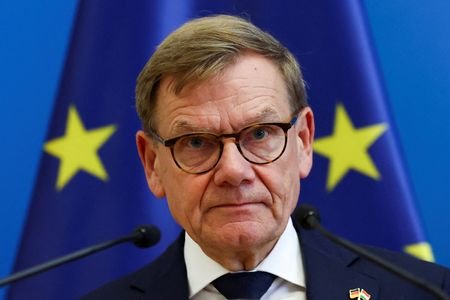
Sept 29 (Reuters) - Russia's imperialism is the greatest threat to Europe and to question that is irresponsible, Germany's foreign minister said on Tuesday in Slovakia, where the prime minister has criticised the West's approach on Ukraine.
"The greatest threat to the freedom of our continent comes from Moscow. The greatest danger to Europe is (Russian President Vladimir) Putin's belligerent imperialism," said German Foreign Minister Johann Wadephul as he met Slovak counterpart Juraj Blanar.
"To question these facts is not only lacking in solidarity, but it would be simply irresponsible."
Slovakia, led by Prime Minister Robert Fico's leftist-nationalist government, has questioned the European Union and NATO's reaction to the war that followed Russia's full-scale invasion of Ukraine in 2022.
Fico has maintained warm relations with Moscow, including meetings with Putin, and battled the EU over measures to end Russian oil and gas supplies, which Bratislava still needs.
This month, Fico criticised unnamed Western politicians for wanting to stoke conflict between NATO and Russia after a "failed" strategy to defeat Moscow.
He also said Europe was closer than ever to war and that he wanted to keep Slovakia out of conflict.
He said in a television interview at the weekend that he did not believe partners would send troops to help Slovakia in a war. Fico has said he would prefer neutrality, but he was bound by NATO membership.
WADEPHUL SAYS OBSTRUCTION IN BRUSSELS IS SELF-DEFEATING
Slovak opposition parties have criticised Fico for calling into question Slovakia's commitment to NATO collective defence.
Wadephul said on Tuesday that states needed to rely on security guarantees, and that casting doubt on NATO's deterrence capability put "all of us at risk".
He also said the EU had already been through "systemic obstructionism" by Hungary under former prime minister Viktor Orban, whose 16-year rule ended in election defeat earlier this year. Orban had often held up EU measures against Russia.
Slovakia earlier this year opted out — together with Hungary and the Czech Republic — of an EU loan for Ukraine, and has delayed sanctions against Russia in the past due to energy policies.
Wadephul said "blockades" in Brussels weakened the EU.
"Ultimately, it harms the party doing the blocking most of all," he said.
(Reporting by Jason Hovet and Jan Lopatka in Prague, Alexander Ratz in Berlin; Editing by Aidan Lewis)