By Victoria Waldersee and Miguel Pereira
CEUTA, Spain, Sept 2 (Reuters) - Residents of Spain's North African enclave of Ceuta took to the streets on Wednesday to protest the handling by Madrid of a migration crisis caused by a deadly border surge in July when at least 72,000 people crossed from Morocco.
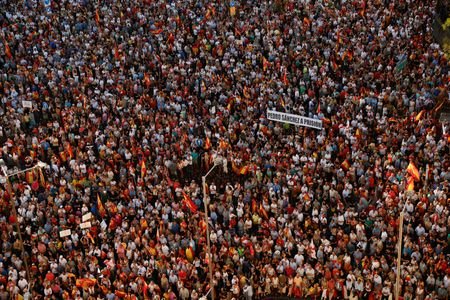
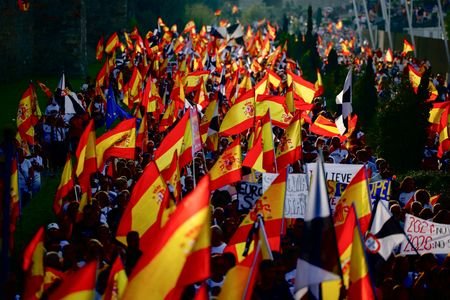
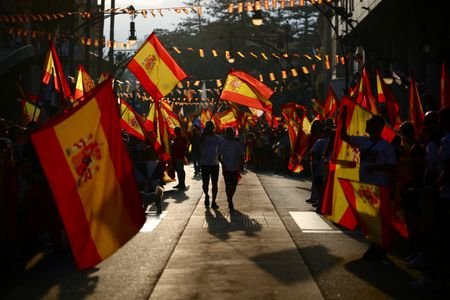
Thousands of people marched through the streets of the city of about 80,000 residents in a protest that coincided with the annual Ceuta Day. Waving Spanish flags and blowing whistles, they chanted: “Ceuta is not for sale, Ceuta must be defended."
One placard read: "SOS. Europe, save us from our traitor government" while some demanded that authorities should “expel the invaders” and others called for Prime Minister Pedro Sanchez to resign as demonstrations also took place in other cities across Spain, including Madrid, Barcelona and Bilbao.
Nearly five weeks after the surge, over 10,000 migrants, including unaccompanied minors, remain stranded in makeshift camps or scattered across streets and beaches in the enclave, according to Ceuta's authorities.
Their presence has triggered near-daily protests by locals against the Spanish government's management of the crisis, with demonstrators calling for the migrants to be sent back to their countries of origin or redistributed across Spain.
"The response has been inadequate, late and, to top it all, has involved a complete dereliction of duty on the part of the government. We cannot be second-class citizens, and our border must not be sidelined," said David Hernandez, a 45-year-old teacher.
Recent protests featured sporadic attacks against a makeshift migrant camp at El Trampolin beach and arrests of Moroccan citizens who lobbed stones and bottles at army patrols.
POLITICAL DEADLOCK HAMPERS SOLUTION
Wednesday's Spain-wide protests were called by the FEMP federation of municipalities, dominated by the main opposition conservative People's Party (PP).
Spain's leftist government distanced itself from the initiative, accusing the right of exploiting the crisis for political benefit.
"This is not about defending Ceuta and the Ceutans, it is about attacking the government," Territorial Policy Minister Angel Victor Torres told radio station RNE.
A manifesto by citizens' initiative 'Por Ceuta' (For Ceuta), which calls for respect for residents' and migrants' human rights, the orderly return of those without the right to remain, and more security reinforcements, has garnered nearly 65,000 signatures. The initiative says it has no political affiliation.
Left-wing collectives and unions organised counter-gatherings in several cities, including Madrid, to condemn "racist and Islamophobic persecutions and attacks" against migrants in Ceuta since the rush.
Negotiations between local and central government on how to handle the crisis are deadlocked, with the PP, which governs most regions, some in coalition with the far-right Vox, calling for all those remaining, including minors, to be deported.
The government has increased capacity at temporary accommodation centres to more than 3,400 places from about 500, and deployed over 1,600 police.
But local groups and political leaders say this still falls far short of what is needed to keep citizens and migrants safe.
"The central government needs to provide funds and the local government needs to provide space ... that's the battle we're in," said Juan Miguel Morales, director of Sur Acoge charity.
"The response has lacked agility: that much is clear."
(Reporting by Victoria Waldersee in Ceuta, Corina Pons, Emma Pinedo and David Latona in Madrid; Writing by Victoria Waldersee and Charlie Devereux; Editing by Gareth Jones and Nick Zieminski)