WASHINGTON, Sept 23 (Reuters) - US President Donald Trump welcomes Chinese President Xi Jinping to Washington on Wednesday for a three-day visit where the superpowers' tensions over trade, technology and Tehran will play out against a backdrop of pomp and ceremony.
For the Chinese leader's first trip to the US in nearly three years, Trump will greet Xi and his wife on the tarmac when they arrive Wednesday evening at the Maryland military base that hosts Air Force One.
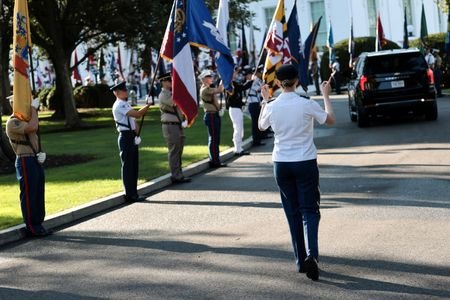
The fanfare was due to include a state dinner with tech luminaries, a White House military ceremony including jet flyovers and a visit to the National Archives where the original Declaration of Independence and Constitution are housed.
Despite their deep disagreements, both sides pressed ahead with the summit, which analysts said seeks to project stability between the world’s biggest factory and its biggest consumer.
Expectations for a breakthrough during Xi's visit were slim.
The countries' 11-month trade truce sunsets in November, but the two sides are at odds on issues ranging from Taiwan to narcotics and rare-earth minerals.
People familiar with the plans said Xi was likely to forcefully raise Beijing's claim to Taiwan, a topic Washington would prefer to avoid, while Trump was likely to maintain firm US export controls despite Xi’s objections.
But talks set for Thursday could nonetheless yield deals to lower tariffs in specific sectors, cooperate on drug trafficking and expand military-to-military dialogue.
Trump is expected to seek the release of some Americans and others detained in China, according to the people.
The two countries could also agree to talk more on AI, where they are in fierce competition but mindful of growing dangers.
The meeting comes at a difficult moment for Trump, who faces falling approval numbers as public discontent with his war on Iran grows. Xi, while also facing challenges at home, arrives in a seemingly stronger position, with his country's trade engine roaring.
The leaders themselves may not feel they need to compromise, analysts said.
"The president very much believes that over time the US economy is going to grow, the US will get stronger," said Edgard Kagan, a former White House official now with Washington's Center for Strategic and International Studies. "I think when Xi Jinping sits down with Donald Trump, he very much believes the US is in hurtling decline, and that time is on China's side."
STATE DINNER WITH AI CHIEFS
A state dinner on Thursday is expected to bring together chiefs of companies important in both markets like Apple's Tim Cook, Nvidia's Jensen Huang and OpenAI's Sam Altman.
As in their prior two meetings since 2025, the leaders are planning a highly scripted public spectacle. Instead of a joint press conference or statement at the end, the countries are expected to issue dueling announcements highlighting what each side hopes to convey to a domestic audience.
For Trump, the trip caps a week of diplomacy that began with a two-day stay in New York for the United Nations General Assembly. Nearly seven months of war with Iran have spiked energy prices in the US, and the president's Republican Party faces tough prospects in November’s congressional elections.
Xi has overseen a surge in China's foreign trade but faces weak household spending and a property market downturn. Sweeping corruption and discipline crackdowns in the military have helped cement Xi’s power but also raised questions about the People's Liberation Army's readiness.
Another meeting between Trump and Xi is seen as likely this year, potentially on the sidelines of the Asia-Pacific Economic Cooperation summit in China in November or the Group of 20 meetings in the US in December.
AREAS OF TENSION INCLUDE IRAN, ELECTIONS, TAIWAN
After imposing triple-digit tariffs on Chinese imports last year, Trump has relaxed policy and rhetoric towards China. One recent exception was a prime-time address in July when Trump renewed accusations, which China denies, that Beijing meddles in US elections.
Iran is likely to feature in the discussions. Beijing has maintained close ties with Tehran, but it's unclear whether it will help Trump break a stalemate in the conflict. Washington thinks Beijing could use its influence over Tehran, but Trump has said he sees no need to seek China's help.
Beijing, the world's biggest oil importer, helped stabilize crude prices after the war started by cutting demand and releasing strategic stockpiles. After promising to unleash "economic D-Day" on countries doing business with Iran, the Trump administration withheld secondary sanctions on major banks in China, Tehran’s largest trading partner.
Xi is also expected to push Trump to decrease arms sales to Taiwan after doing so at the last meeting in Beijing. In December, the Trump administration approved an $11 billion arms sale to Taiwan, the largest ever. But a second package, worth some $14 billion, has been on hold for months. Trump has described the arms sales as a “very good negotiating chip.”
(Reporting by Trevor Hunnicutt; additional reporting by David Brunnstrom, Yimou Lee and Ben Blanchard; Editing by Don Durfee and Cynthia Osterman)