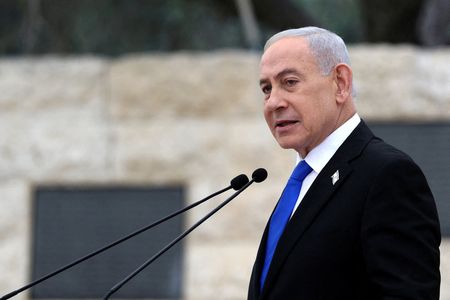
JERUSALEM, May 13 (Reuters) - The United Arab Emirates' foreign ministry denied on Wednesday a statement by Israeli Prime Minister Benjamin Netanyahu's office that he visited the country and held a secret meeting with its president.
The Israeli Prime Minister's Office said earlier he travelled to the UAE during the war with Iran and met Sheikh Mohammed bin Zayed.
A statement by the Emirati foreign ministry said that Emirati relations with Israel "are public" and "not based on non-transparent or unofficial arrangements."
"Any claims regarding unannounced visits or undisclosed arrangements are entirely unfounded unless officially announced by the relevant authorities in the UAE," the statement said.
Netanyahu's office said the meeting resulted in an "historic breakthrough" in relations between the two countries.
A source familiar with the meeting said Netanyahu and Sheikh Mohammed met in Al-Ain, an oasis city by the Oman border, on March 26 and that their meeting lasted several hours.
The source said that Mossad Chief Dedi Barnea made at least two visits to the UAE during the war with Iran to coordinate military actions. The intelligence chief's visit was first reported by the Wall Street Journal.
Especially after coming under attack during the Iran war, the UAE has strengthened its relationships with the United States and Israel, with which it opened ties in the 2020 Abraham Accords. It views the relationship with Israel as a lever for regional influence and a unique channel to Washington.
Israel sent batteries for its Iron Dome interception system and personnel to operate them to the UAE during the war, U.S. Ambassador to Israel Mike Huckabee said on Tuesday.
The UAE is a regional business and financial hub and one of Washington's most important allies. It has pursued an assertive foreign policy and carved its own sphere of influence across the Middle East and Africa.
Iran's strikes on Gulf states in response to the U.S.-Israeli attacks targeted the UAE more than its neighbours, hitting civilian infrastructure and energy facilities.
Unlike several Gulf peers, the UAE has a pipeline that allows it to divert some oil exports around the blockaded Strait of Hormuz, making it more able to withstand prolonged disruption. But the war risks severely damaging its role as a global economic center that offers security and ease in the region.
(Reporting by Emily Rose, Rami Ayyub , Muhammad Al Gebaly and Yoman Ehab Editing by Philippa Fletcher and Sanjeev Miglani )

