By Sarah Young
LONDON, June 5 (Reuters) - Britain is running out of time to boost its defences in response to the threat posed by recent Russian actions, the country's military chief said on Friday, after months of delays to the country's Defence Investment Plan.
"Russia is definitely raising the stakes and risks crossing a line," Chief of the Defence Staff Richard Knighton told BBC Radio. "We need to spend more on defence and do it faster."
The Defence Investment Plan will lay out the funding for military equipment and services to ensure the armed forces move to a state of "warfighting readiness", but reports say it has been held up since last year by budget rows within government.
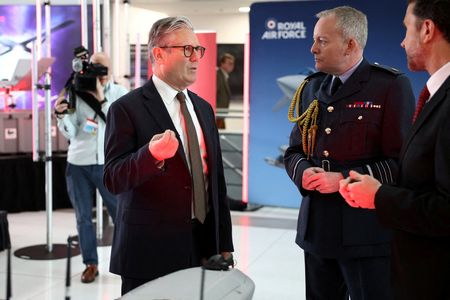
Prime Minister Keir Starmer confirmed on a visit to a drone factory on Friday that the plan would be published before a July 7 NATO summit, following a period of close work between government and military leaders.
"It is no exaggeration to say that we're living in more dangerous and volatile times than at any time in my life," Starmer said.
U.S. President Donald Trump, who has repeatedly called on Starmer and other European leaders to spend more on defence and become less reliant on Washington for the continent's security, is due to attend the summit.
THREATS GREATEST SINCE COLD WAR
Knighton said the risks and threats to Britain were greater than at any time since the Cold War, and the government needed to spend on defence accordingly.
"The challenge for ministers is to make those difficult trade-off decisions," he said.
Media reports say military chiefs have warned Starmer that there is a £28 billion shortfall in funding over the next four years, and say that is behind the delay to the investment plan.
Starmer has pledged the largest sustained increase in defence spending since the Cold War, aiming to lift it to 3% of national output in the next parliament, but he has been criticised for not following through on his promises.
George Robertson, who served in the 1990s as Britain's defence secretary and then as chief of NATO, said in April that there was a gap between Starmer's rhetoric and action and he was "not willing to make the necessary investment" in defence.
Knighton said Russia was stepping up its threat, with more incursions into British airspace and through regular "probing, challenging, testing" of defences, as well as being behind cyberattacks, sabotage and attempts to steal technology.
"We do need to step up and enhance our capability as the threats from potential adversaries grow," he said.
(Reporting by Sarah Young; Editing by Alex Richardson, William Maclean)