By Lina Golovnya and Andrew Osborn
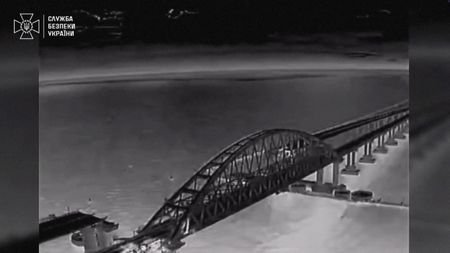
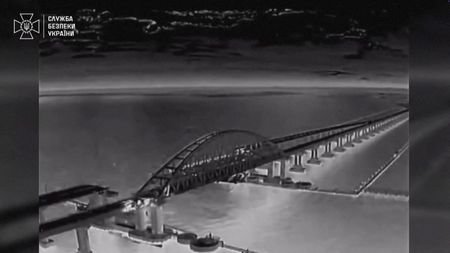
KYIV/MOSCOW, Nov 17 (Reuters) - Ukrainian drones and missiles destroyed the central road section of the bridge linking Russia and Crimea on Tuesday, inflicting a military and symbolic blow on President Vladimir Putin two days before he is due to meet the leaders of China and the US.
Videos and images posted on X by Ukrainian President Volodymyr Zelenskiy and verified by Reuters showed the bridge's main road arch had crumbled into the sea, leaving a yawning gap.
"Russia strikes our infrastructure every day, including bridges," Zelenskiy said. "We are ... reminding Russia that war will always return to where it began."
The 19-km (12-mile) bridge is a flagship project inaugurated by Putin in 2018 and a symbol of Russia's attachment to the peninsula it captured and annexed from Ukraine in 2014.
The timing was awkward for the Kremlin leader ahead of his meeting in Shenzhen on Thursday with US President Donald Trump and China's Xi Jinping, where the three are expected to discuss the Ukraine war among other topics.
Zelenskiy said the strike followed an unprecedented operation that methodically destroyed Russian air defences, radar systems and electronic warfare capabilities.
Sergei Aksyonov, Crimea's Russian-installed governor, said two people were killed and road traffic had been suspended. Rail traffic partially resumed after a pause.
KREMLIN SAYS RUSSIA WILL REBUILD IT
Putin's spokesman Dmitry Peskov said a repair plan would be prepared, making the bridge "even better than before".
But Russian military bloggers said repairs would be exceptionally challenging given Ukraine's capacity for further attacks.
Finnish military analyst Emil Kastehelmi posted on X: "The road bridge won’t be repaired during this war ... Ukraine has achieved a victory with both concrete and symbolic implications."
The bridge over the Kerch Strait was once a key supply route for Russian forces in Ukraine, but the military now relies more heavily on a land corridor running through parts of eastern and southern Ukraine that Russia has captured since launching a full-scale war with its neighbour in 2022.
Russian Deputy Prime Minister Marat Khusnullin said a government commission had met to decide on steps to assess damage, launch repairs and discuss the logistics of delivering cargo to Crimea via alternative routes.
IMPLICATIONS FOR SHIPPING
The bridge spans a channel used by commercial vessels entering and leaving the Sea of Azov, making it an important part of the region's grain export network.
While Black Sea grain shipments have largely stalled amid escalating drone attacks, export infrastructure has suffered limited damage, meaning trade could resume quickly if security conditions improve.
Andrey Sizov, of consultancy Sovecon, said the bridge's collapse could "substantially delay any eventual resumption of shipping from the Sea of Azov" because debris would have to be cleared from the channel.
Ukraine has attacked the bridge several times during the war. A truck bomb in October 2022 killed four people and limited the bridge's capacity for several months. In July 2023, a section of road bridge was destroyed and a couple crossing by car were killed.
LARGEST UKRAINIAN DRONE ATTACK
The overnight attack was part of what Russian state media called Ukraine's biggest drone attack yet. Russia said it shot down 1,441 drones over 22 regions, surpassing the previous record of 1,336 set on Monday.
Air defences repelled a major drone attack on the industrial cities of Ufa and Salavat in Russia's Bashkortostan region, home to several oil refineries, state media reported, citing local officials. Ukraine said it had hit a refinery and petrochemical complex in Salavat.
Moscow Mayor Sergei Sobyanin said that around 800 Ukrainian drones had flown towards the surrounding Moscow region, 321 of which had been brought down en route.
The scale and frequency of Ukrainian drone attacks have increased as Russia has intensified its own drone and missile campaign in a grinding war of attrition, with both sides targeting energy infrastructure and other strategic assets.
Attacks have continued despite US-brokered peace talks in Abu Dhabi last week, the first in nine months, and separate meetings between US envoys and Putin and Zelenskiy.
Kyiv and Moscow agreed on a major exchange of prisoners during last week's talks but there was no significant breakthrough on broader issues, including territory. Russia holds about a fifth of Ukrainian land but the front line has remained largely static for months.
KYIV'S BRIDGES STRUCK
In Kyiv, Reuters witnesses reported a series of loud explosions in the capital overnight.
Vitali Klitschko, Kyiv's mayor, said Russia struck the city's North and South bridges, an assertion later confirmed by Moscow, and partially damaged the metro system. The attacks caused some power and water outages and prompted transport restrictions, he said.
Overnight Russian strikes on energy infrastructure left consumers without power in eight Ukrainian regions, Deputy Energy Minister Artem Nekrasov said.
Russia said its forces had struck transport, military and energy facilities in Kyiv, Zaporizhzhia, Cherkasy and Dnipropetrovsk, along with port infrastructure and a cargo ship.
Reuters could not immediately independently confirm the reports. Both sides deny deliberately targeting civilians.
(Reporting by Reuters in Moscow and Kyiv; Writing by Andrew Osborn and Mark Trevelyan; Editing by Andrew Cawthorne)