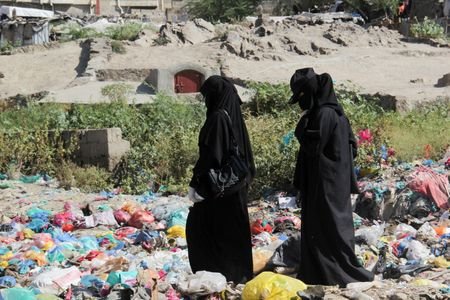
TAIZ, Yemen, Nov 6 (Reuters) - Two single mothers who fled their village three weeks ago are struggling to keep their children fed and warm in the besieged Yemeni city of Taiz, where they live in a damaged building and sell plastic bottles to get by.
Taiz hosts about half of the 300,000 people displaced across Yemen by the latest fighting, according to the UN. The city has been largely isolated since October 3, following an escalation in clashes between the Saudi-backed government and the Iran-aligned Houthis. The fighting has prevented humanitarian supplies from entering and civilians from leaving.
Fatima Abdullah Qassem said the families fled on foot in the middle of the night when fighting reached their village of al-Sayahi in the al-Dhabab area west of Taiz.
The family spent two days sleeping on the street because the damaged building they are currently living in was so dirty, she said.
"The building is open, see, it's open with tarpaulins set up. We put up tarpaulins, and it's freezing. We have no blankets, we have nothing, I swear to God," she says, gesturing to their makeshift living space.
Qassem, a mother of eight who is separated from her husband, lost one of her sons in a landmine explosion in 2017.
She and another mother, Intizar Ahmed Saeed, used to sell vegetables but have now turned to collecting and selling plastic bottles to support their children.
Saeed, a widow and mother of seven, said the money she can scratch from this is not enough to even feed her children.
"My life is a struggle every day, by God, a struggle. I tell you, I work for 1,500 (rials, or $0.96) and it is not enough. I go begging for potatoes, tomatoes, pepper... I have girls, all of them inside, where do I take them? There's no one to work hard to look after them. The man of the house (referring to her son) is 15 years old, and these days there's no work," Saeed said.
(Writing by Emily Giles, Editing by Xevi Fontdegloria)