
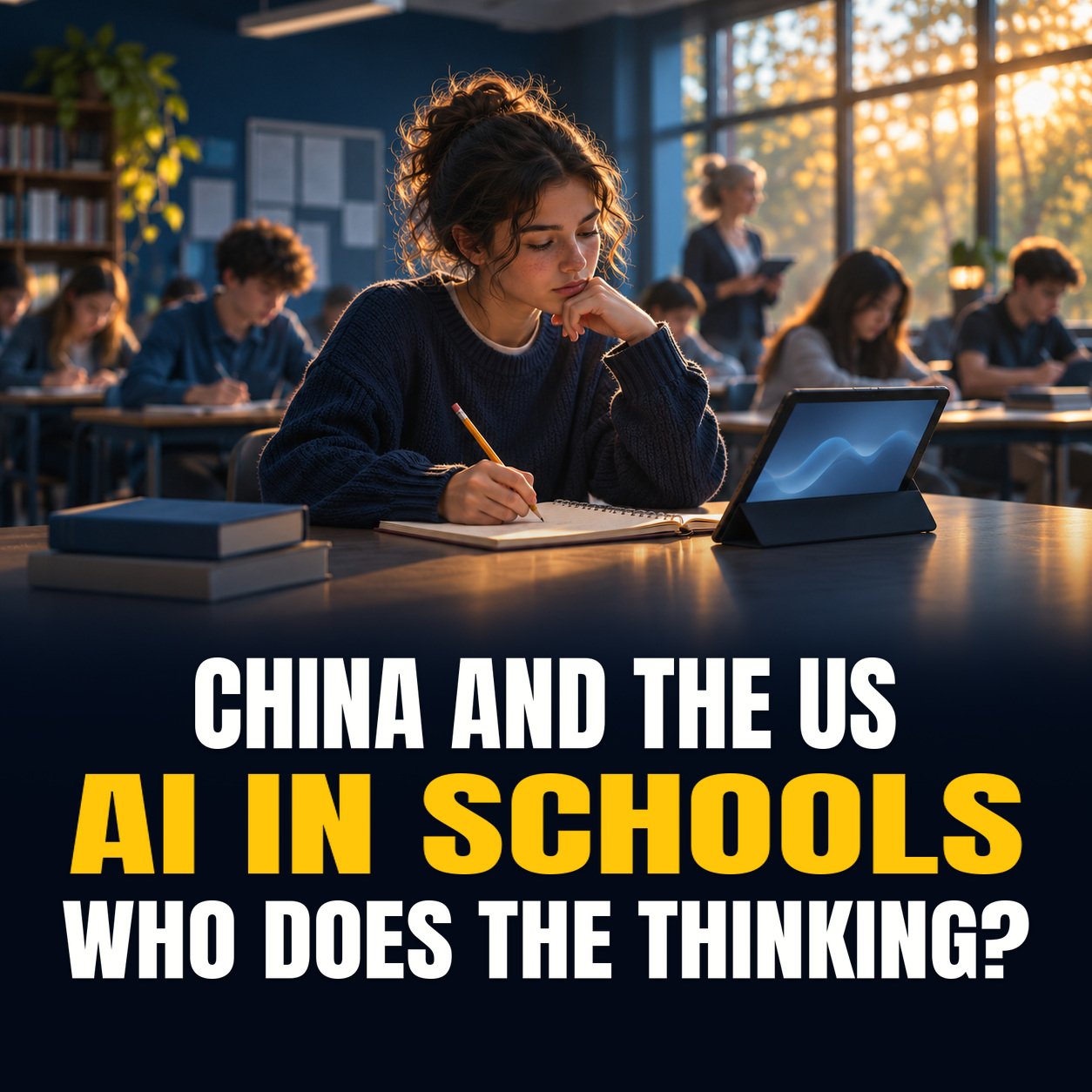
China wants artificial intelligence literacy to be universal among schoolchildren by 2030, bringing its technology competition with the United States into classrooms. A Reuters investigation published on 16 November found that Chinese schools are already experimenting with AI in different ways, with no settled definition of what all pupils should know or how schools should measure it.
The distinction matters. Teaching a pupil how to question an AI-generated answer is a different proposition from giving them a chatbot that answers homework questions. The first can build a skill; the second can make it harder to tell whether they learnt anything.
Two countries, different approaches
China’s AI Plus Education plan calls for dedicated classes as well as AI teaching across existing subjects. It also encourages hands-on and after-school activities. Reuters found schools moving at different speeds, despite the breadth of the national ambition. Universal literacy is a target, not a description of what classrooms already offer.
In the US, a 2025 executive order promoted early exposure to AI and training for educators, but schools are working within a more decentralised system. Stanford’s 2026 AI Index found that only about half of US middle and high schools had AI policies, and few teachers considered the rules clear. National encouragement can coexist with very different expectations from one school to the next.
What the evidence says about learning
Better scores with a chatbot open do not necessarily translate into better scores when it is closed. In a study of nearly 1,000 high-school maths students in Türkiye, an unrestricted AI tool improved practice performance, but students using it did worse than students without AI when they later sat an assessment unaided. A version designed to give teacher-guided hints reduced that harm.
That is one study in one subject. The OECD’s 2026 review finds that generative AI can support learning when it serves a clear teaching purpose, but that using it to finish tasks can improve the work on screen without improving what a pupil knows.
What schools can do now
An AI literacy lesson could have pupils solve a problem first, then ask a tool for one hint and test that hint against their own reasoning. In a writing class, they might compare a chatbot’s explanation with a reliable source and identify where the answer is wrong or incomplete.
Teachers can set clear rules about when AI is allowed, ask pupils to show their working and keep some assessments AI-free. Schools should also choose age-appropriate tools and be clear about what personal information pupils must keep out of them.
Why it matters
The useful measure of AI literacy is whether pupils can decide when to use a tool, question what it tells them and still solve problems on their own. Tracking what students can do unaided gives schools a better test of progress than how often they use AI.
Sources
Reuters — Inside China’s drive to build an AI-native generation
China State Council — AI Plus Education plan
White House — Executive Order on AI education
Stanford HAI — 2026 AI Index: Education
PNAS — High-school maths experiment
OECD — Digital Education Outlook 2026