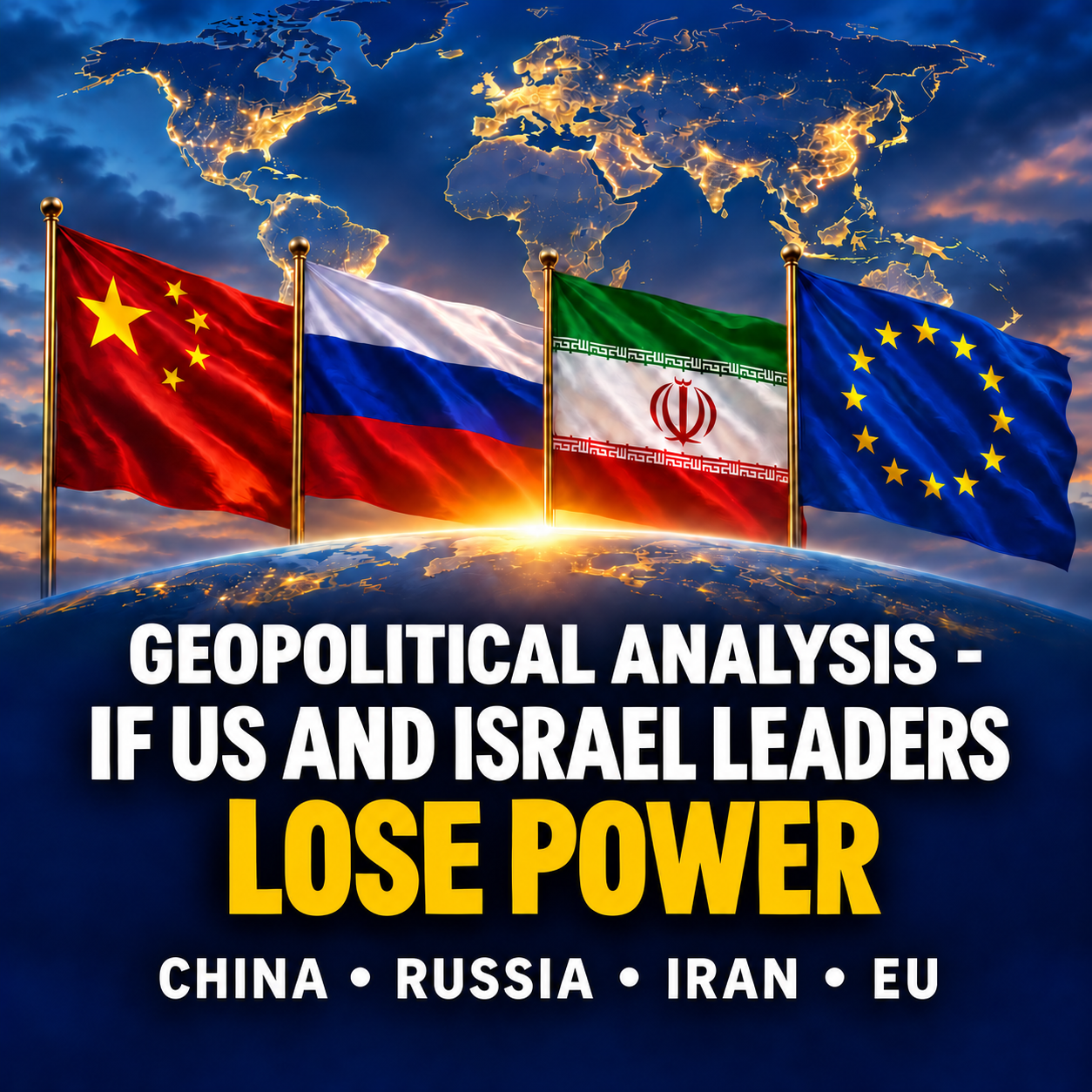
Two setbacks in one week
Within a single week, the two leaders who launched the 2026 war on Iran both lost at the ballot box. Neither is out of office yet, but both have lost the political room they had a month ago, and capitals from Beijing to Brussels are recalculating.
This geopolitical analysis looks at how China, Russia, Iran, the European Union, the Gulf states and the wider world are reading the two results, and what they stand to gain or lose.
In Israel's election on 27 October, Benjamin Netanyahu's bloc won 53 of 120 Knesset seats, eight short of a majority. The opposition bloc took 48, and Arab-led parties won a historic 19, which leaves them holding the balance of power (PBS). Netanyahu stays on as caretaker and is making unproven claims that the vote was "stolen" with foreign help. If coalition talks fail, Israel faces another election early next year.
In the US midterms on 3 November, Democrats won both chambers of Congress. CBS projects 251 to 268 House seats and at least 54 Senate seats, including flips in Texas, Ohio, North Carolina and Maine (CBS News). Donald Trump remains president until 2029, but he now faces a hostile Congress. Vice President JD Vance put the cause in five words: "The reason we lost is the war." Trump himself said it was "largely true" that the Iran war cost Republicans seats through gasoline prices.
The war began on 28 February 2026 with joint US–Israeli strikes on Iran. Iran answered with attacks on US forces and Gulf states, the Strait of Hormuz closed, and oil prices spiked (Wikipedia). That shared war is why the world is reading the two results as one story.
China: quiet satisfaction, careful words
Beijing's official line is studied neutrality. Foreign Ministry spokesperson Mao Ning called the midterms a "domestic affair" and said China would keep a "constructive strategic" relationship with Washington (Al Jazeera).
Behind the restraint, China has reasons to be pleased. It condemned the original strikes on Iran and called emergency UN Security Council sessions with Russia. As the world's largest oil importer, it also paid for the Hormuz shock. A Congress set on ending the war points toward lower energy prices and a calmer Gulf, which serve Chinese growth.
There are risks too. Democrats are no softer on China than Republicans on technology controls, Taiwan or human rights, and a Congress that holds Trump back on Iran may push harder on Beijing to show it is tough. China's most likely play is to wait, avoid giving Washington a reason to unite against it, and present itself to the Global South as the steady power while the US argues with itself.
Russia: a loss of leverage
Moscow is the clearest loser among the major powers. Deputy Foreign Minister Sergei Ryabkov said the Democrats' return "bode ill" for US–Russia ties and called the party's approach "extremely negative". He added that Russia's policy on Ukraine will not change because of other countries' elections (KPBS/AP).
The Iran war was good business for the Kremlin. With Hormuz closed, Russian oil profits reportedly reached about $760 million a day, and fossil fuel exports in March hit a two-year high. Russia also shared intelligence with Iran and, during the ceasefire, helped restock its missiles (Wikipedia). A Congress that pushes to end the war threatens that windfall.
Ukraine is the bigger worry. Democrats in control of the budget are more likely to fund Kyiv and harden sanctions, and the Kyiv Independent called the result a "potential boost for Ukraine." Russian state media is already trying to split the West, with Rossiyskaya Gazeta warning: "Brussels, brace yourself. After the Republicans' defeat, Trump's wrath will fall on Europe."
Iran: claiming a political victory
Tehran is reading both results as proof that the war failed. Parliament Speaker and chief negotiator Mohammad Bagher Ghalibaf wrote that "Americans said NO TO WAR," and warned that if Washington ignores its voters, it "will learn our NO comes with a Nightmare" (Al Jazeera). The Tehran Times put it more bluntly: the Iran war "comes home to hit Trump at the ballot box."
The practical gains could be real. Democrats have promised a bill to stop the war, and in Israel the main architect of the Iran campaign may lose power. Both would narrow the room for a new round of strikes and could give Iran a better hand in any talks.
But Iran should not expect too much. Trump keeps his veto and his powers as commander in chief, and repeated after the vote: "You can't let Iran have a nuclear weapon." Israel's opposition leaders, including former army chief Gadi Eisenkot, also see Iran as a serious threat. A change of government in Jerusalem would change the style of policy more than its goals.
European Union: relief, but no return to the old order
Europe's mood is cautious relief. European Parliament Vice President Christel Schaldemose said she was "cautiously optimistic on Europe's behalf," but added that the EU standing on its own feet is "not up for debate" (Al Jazeera).
National leaders split along familiar lines. Spain's Pedro Sánchez, a sharp Trump critic, said Americans voted against "climate denialism" and policies that "only impoverish." Germany's Defence Minister Boris Pistorius called it a "historic victory" but promised to keep working with the administration and both parties. France said it will watch whether Trump changes course, especially on fuel prices (KPBS/AP).
For Brussels the stakes are concrete:
- Energy: an end to the Iran war would ease the oil and gas prices hurting European industry and households.
- Ukraine: a Democratic Congress makes steady US aid to Kyiv more likely, sharing a burden Europe has carried largely alone.
- Trade and Gaza: a post-Netanyahu government could reopen talks on Gaza and the EU–Israel relationship, which have been frozen by disputes over the war.
- Risk: a president blocked at home may turn to tariffs and foreign policy, where he acts alone, as Russian media is predicting.
The Gulf, the Global South and US allies
Gulf states were hit directly by Iranian attacks and the Hormuz closure, so an end to the war is in their interest. Qatar is also caught in Israel's post-election fight: Likud members accused it of interfering in the vote, which Doha called "ridiculous and dangerous" (PBS). A new Israeli government could ease that tension and restart Gaza diplomacy.
The Global South sees a shift in direction. South Africa's Cyril Ramaphosa called the vote "a new era in world relations" (KPBS/AP). Oil importers across Asia and Africa, from India and Pakistan to Kenya, mainly want fuel prices down and trade routes open.
Close US allies are stressing continuity. Japan said its US alliance "remains the cornerstone" of its security, Britain said ties are unchanged, and Greece said the result will not affect relations. Their message is that they deal with the US as a state, not with one party.
Geopolitical analysis: what changes, and what doesn’t
The biggest shift is to the war. With both leaders weaker at home, a long US–Israeli campaign against Iran is now much harder to sustain. Iran, China, the Gulf and Europe gain from that; Russia loses its oil windfall and faces a Washington more willing to back Ukraine.
The limits are just as important. Trump keeps the presidency, his veto and his control of foreign policy until January 2029. Netanyahu remains caretaker, and a messy coalition fight or a new election could still bring him back. Foreign capitals are therefore not betting on a new order yet. They are hedging, and waiting to see whether these defeats at the ballot box become changes in policy.
Related on Quews News
- Trump's political humbling signals short-term gain, long-term pain for China
- Russia's Dmitriev in Washington for first US contact since Trump's midterm setback
- Beaten at home, Trump faces stark choice on Iran: deal or escalation
- Vance repudiates Iran war after US electoral defeat
- Democratic Congress could test decades of US support for Israel
Sources
- CBS News: Election Day 2026 midterms live updates
- PBS NewsHour: Difficult negotiations lie ahead in Israel
- Al Jazeera: 'Seismic shift': World reacts to US midterm election results
- KPBS/AP: World reacts to Democrats' midterm elections victory
- Wikipedia: Russia in the 2026 Iran war
- Wikipedia: 2026 Israeli legislative election