Nov 25 (Reuters) - Late one January night, platoon commander Pee Litt led a group of Myanmar resistance fighters into a village in the country's central Bago region, where eight of their comrades had been killed and their bodies left behind.
As he cleared a path across an area strewn with landmines, two blasts wounded his comrades, before Pee Litt himself stepped on a mine.
"I had always known that if I stepped on one of these mines, I would lose my foot," the 28-year-old said, recalling the explosion that tore off his right leg below the knee.
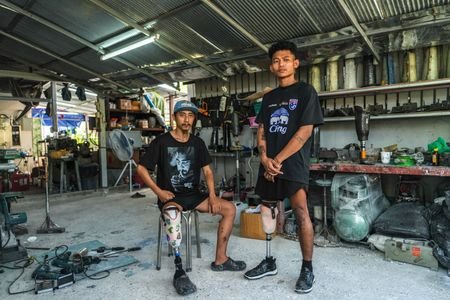
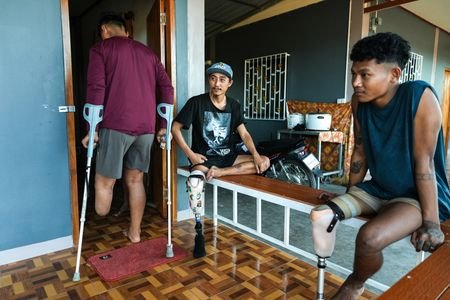
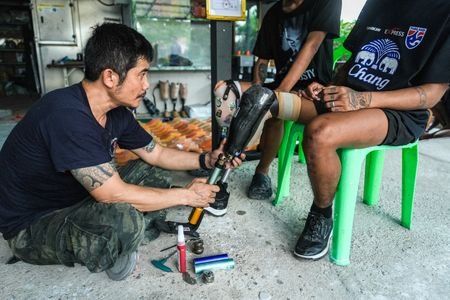
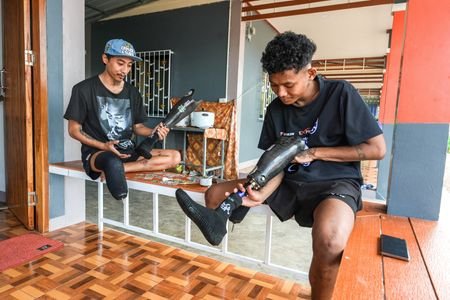
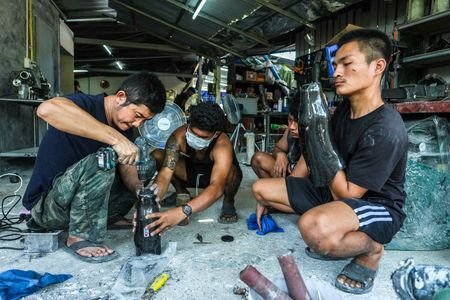
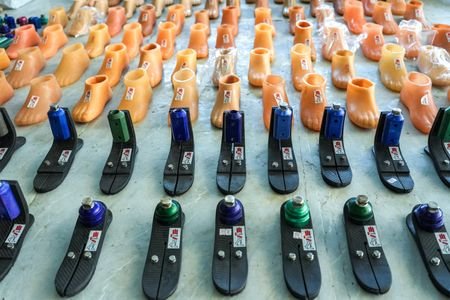
Pee Litt spoke to Reuters inside a small workshop near the Thailand-Myanmar border, a nondescript single-storied house where a group of young men were assembling prosthetic limbs, their hands covered with grease and oil. Dozens of artificial legs lay carefully arranged nearby.
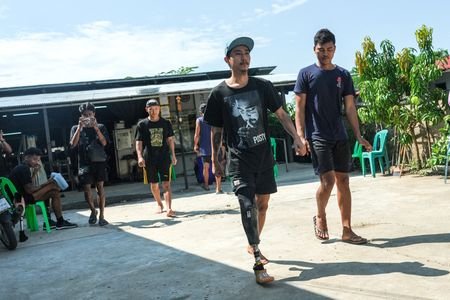
"I dared to do this work because I can live my life with a prosthetic," said Pee Litt after he tried out a prosthetic leg, speaking of his frontline duties that included mine clearance.
"I can live without legs but I cannot live under the military."
Myanmar recorded the world's highest number of casualties from landmine and explosive remnants of war for the third consecutive year in 2025, with 1,891 people killed or injured, according to a Landmine Monitor report released on Tuesday.
In all, more than 5,700 people have been injured or killed by landmines and other explosive remnants in Myanmar since 2021, when a military coup triggered a devastating nationwide civil war in the impoverished nation.
Amid the relentless fighting, landmines — small but deadly — have become a weapon of choice for the military and the array of armed groups opposed to it, leaving a bloody trail of grievous wounds, severed limbs and, sometimes, death.
"The casualty total (in Myanmar) is going from crisis to catastrophe," said Yeshua Moser-Puangsuwan, a senior researcher at Landmine Monitor.
"We're talking about five people every day who become injured or killed by an anti-personnel landmine. That is an extraordinary burden for a country to bear."
A spokesperson for the Myanmar military did not respond to questions from Reuters.
A spokesperson for the rebel National Unity Government, which runs the armed group that Pee Litt is a part of, also did not respond.
NOWHERE SAFE ANYMORE
Both sides in Myanmar's protracted civil war, which has killed over 100,000 people and displaced over 3.5 million, are deploying mines, leaving almost two-thirds of the country contaminated with the munitions, according to Moser-Puangsuwan.
"It basically means there's nowhere safe anymore," he said, adding that shifting frontlines and displaced civilian populations in Myanmar lead to more casualties than in places like Ukraine.
Armed groups, including those aligned with the military and those opposed to it, are also using the munitions, according to Landmine Monitor, with resistance groups in possession of very large quantities of anti-personnel landmines seized from the military.
"We can't not lay mines," said Pee Litt, explaining how resistance fighters saw landmines as necessary to protect frontline positions against a far better-resourced opponent.
The result is growing casualties for those not involved in the fighting, even as international organisations are unable to conduct land assessment and landmine clearance.
At least 487 civilians — including 113 children — were killed or injured by landmines and other explosive ordnance in the first six months of 2026, according to data from the United Nations children's agency.
BORDER WORKSHOP
Within Myanmar, the main providers of artificial limbs are multiple rehabilitation centres supported by the International Committee of the Red Cross, which supported 5,730 survivors between 2021 and 2025.
But these ICRC facilities are primarily in towns and cities controlled by the military, leaving victims like Pee Litt no option but to travel for a week to the small workshop on the Thai-Myanmar border for prosthetic limbs.
In the two years since it was founded, the i-walk prosthetics centre run by former Myanmar nurse Ngu War War Hlaing has made and fitted prosthetic limbs for 150 people wounded in the fighting in her home country.
"Over 90% are victims of landmines. When you ask them, it's always because of M14 or M16 mines," she said, referring to copies of two US-designed anti-personnel mines that are manufactured by Myanmar's military.
After arriving at her workshop, following a gruelling journey that included covering long distances on crutches, Pee Litt's had his leg measured, before he waited a few days for the prosthetic to be prepared.
Once ready, he practised walking on the limb that cost around $1,700, paid for by online crowdfunding, for a few days while technicians at the workshop checked its fit — a process that typically takes a week.
But the platoon commander is eager to return to his frontline battalion.
"I need to stay strong for my comrades," he said. "I need to set an example: don't worry, even without one leg, everything is fine."
(Reporting by Reuters staff; Additional reporting by Panu Wongcha-um; Editing by Devjyot Ghoshal and Raju Gopalakrishnan)