By Tom Balmforth
LONDON, July 30 (Reuters) - Russia used a North Korean missile for a strike on a village that killed five members of the same family, Ukrainian President Volodymyr Zelenskiy said on Thursday, in what would be the first time such a weapon has been fired in the war in nearly a year.
Russia has launched North Korean missiles at Ukrainian targets before, but their first deployment since August points to a fresh stock of weapons that Moscow can draw on as it steps up missile attacks, a military source told Reuters.
Russia pounded Ukraine with dozens of missiles and hundreds of drones in an overnight attack that killed at least nine people, officials said, at a time when the Ukrainian military is grappling with an acute shortage of high-end air defences.
The use of North Korean missiles would fit a pattern in which Russia has been shifting to using more ballistic missiles like its Iskander 9M723, which can only be intercepted by U.S.-made Patriot air defence systems, the military source said.
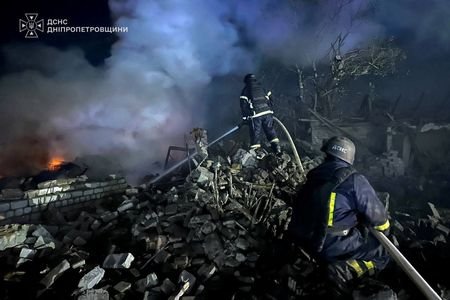
Zelenskiy said one missile flattened a home in the village of Radushne near the Ukrainian city of Kryvyi Rih, killing two parents and three of their children.
The fate of their remaining four children was unclear, as was that of their 1-1/2-year-old grandson, he said.
In his evening address, Zelenskiy said preliminary data showed the missile used to hit Radushne was North Korean. Reuters had reported earlier that the missile used for the strike was likely North Korean, according to two sources.
The Russian Defence Ministry and Ukrainian Air Force did not immediately respond to requests for comment. The North Korean embassy in London did not answer a phone call to request comment outside office hours.
POWERFUL MISSILE
A military source, who requested anonymity because of the sensitivity of the matter, said Ukrainian radars had picked up two missile tracks characteristic of North Korean KN-23 or KN-24 short-range ballistic missiles flying towards Kryvyi Rih during the attack.
Two radar tracks typically indicate four missiles were fired, the source said, adding that other impact sites were not known to him.
For a conclusive assessment, investigators needed to study missile fragments found at the site, a process still under way, the source said, adding that he was nonetheless confident it was a North Korean missile.
Russia began firing North Korean KN-23 and KN-24 missiles at Ukraine towards the end of 2023.
The North Korean missiles have a larger warhead and longer range than Russia's Iskander short-range ballistic missiles, although they are less accurate, the military source said.
In 2024, North Korea sent 14,000 troops to help Moscow's forces repel a Ukrainian incursion into Russia's Kursk region. It has also supplied millions of artillery shells for the Russian war effort.
Last week, Zelenskiy warned the Kremlin wanted North Korea to send another 30,000 troops and said Russian preparations were under way to receive them in Voronezh region.
(Reporting by Tom Balmforth in London and Lizzie Johnson in Kyiv; editing by Mike Collett-White and Rod Nickel)