By Gabriel Stargardter, John Irish and Michel Rose
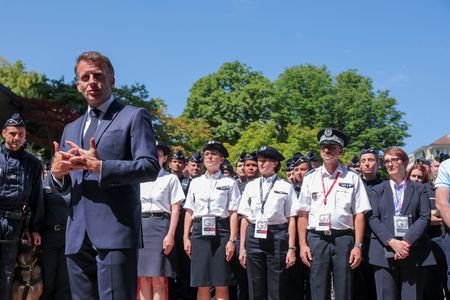
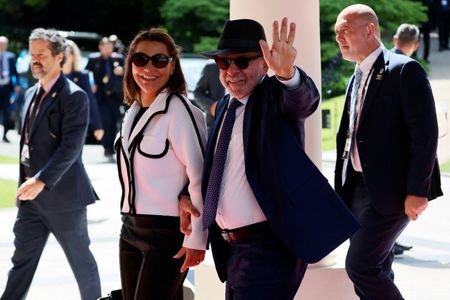
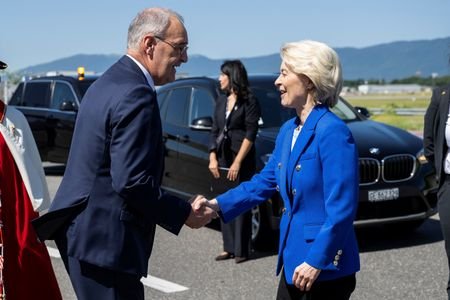
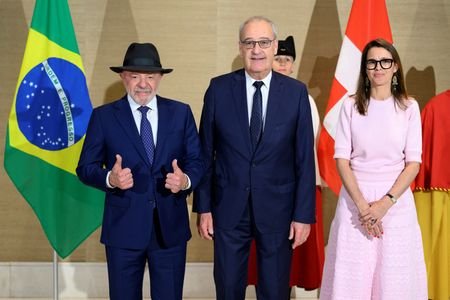
EVIAN-LES-BAINS, France, June 15 (Reuters) - The leaders of the Group of Seven nations began arriving at a French lakeside resort on Monday, with relief after the United States reached a preliminary deal to end the Iran war tempered by unease over President Donald Trump's fresh tariff threats.
The preliminary deal with Iran and the steps to follow will be among several issues the leaders will wrestle with during the June 15-17 summit in Evian-les-Bains.
They will also seek common ground on the war in Ukraine, tackling global economic imbalances and sourcing critical minerals outside of the dominant supplier China.
Trump arrives at a time when global leaders are increasingly wary of the United States, even if French officials were glad to have secured his presence after he left last year's G7 summit in Canada early.
TRUMP THREATENS TARIFFS ON FRENCH WINE
Underscoring the tensions, Trump in an interview with the New York Post before leaving for the summit warned that he would "have no choice" but to apply 100% tariffs on French wine unless Paris eliminates its digital tax on U.S. tech giants.
Then, in a social media post just before arriving at the summit, he turned to a subject that has been a regular source of tension with centrist European allies: immigration.
"Sadly, if you import people from Third World Countries, you quickly become a Third World Country — And there's not a thing you can do about it," he wrote.
Trump's tariff threats, which came ahead of a summit that serves as the diplomatic culmination of Emmanuel Macron's second and final term, represent a blow for the unpopular French president. He steps down next year.
Macron is increasingly seen as a lame duck domestically but still has pull on the global stage, and was able to get Trump to agree to a glitzy dinner at the Palace of Versailles on Wednesday to mark 250 years of U.S. independence.
Macron told French television channel TF1 that France would not yield to Trump's tariff threats, adding, "tariffs don't do anyone any good, especially tariffs between G7 countries."
TRUMP REMAINS UNPREDICTABLE
Trump's comments on tariffs and immigration underline why he is viewed as a volatile partner by other G7 leaders. Many of them have been directly impacted by unilateral Trump decisions that have upended the Middle East, global trade and diplomacy, and prompted deeper soul-searching over the U.S. commitment to the post-war global order it helped establish.
During the summit, Trump is due to meet Middle Eastern leaders and attend a working session with Ukrainian President Volodymyr Zelenskiy.
The Zelenskiy meeting on Tuesday comes at a time when Russian advances in Ukraine have slowed and Ukraine seeks more military funding from its allies, but also after a barrage of attacks on Kyiv.
"This attack only strengthens our determination to do everything, with our allies and partners, to work towards a ceasefire that Russia stubbornly refuses, then to peace. We will work on it at the G7," Macron said in a post on X.
Zelenskiy said on Monday he had offered to meet Russia's President Vladimir Putin at the G7 summit for talks to end their more than four-year-old war, but Putin was not ready to speak.
Zelenskiy's hand has improved since Trump famously told him in the Oval Office last year: "You don't have the cards."
But he may find greater U.S. support elusive as Trump prioritises drawing a line under the Iran conflict, which has dented his support domestically.
DETAILS OF IRAN DEAL
G7 leaders will be keen to learn the details of the U.S.-Iran deal. A memorandum of understanding is scheduled to be signed on Friday in Switzerland but precise terms are unclear.
Trump said the Strait of Hormuz, a major shipping route for global oil and gas supplies that Iran has effectively shut down for months, would open on Friday, and that he had ordered the end of the U.S. blockade of Iranian ports.
France and Britain have been working on a military plan to send a mission to the region that would help open the Strait, although that would depend on Tehran's green light.
"With the ceasefire, it boosts the chances of the G7 being more constructive as we can now really talk about something operational, which we can work on collectively," said a senior French official.
The leaders are not expected to have detailed discussions of what should be done - assuming the deal is signed - with Iran's highly enriched uranium, its ballistic programme or frozen Iranian assets. These issues will entail complex, technical negotiations.
At the summit, Macron also wants to push for action on global macroeconomic imbalances. But Trump's warning on tariffs may cause some friction, particularly as French officials had said the digital tax would not be an issue for the G7.
(Additional reporting by Julia Payne; Editing by Chizu Nomiyama, Neil Fullick, Alison Williams and Gareth Jones)