By James Mackenzie
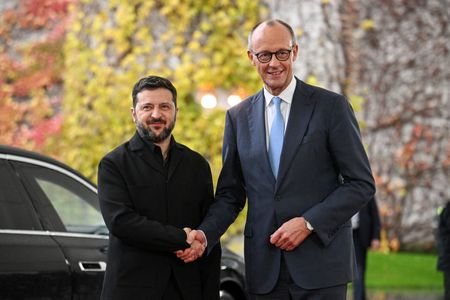
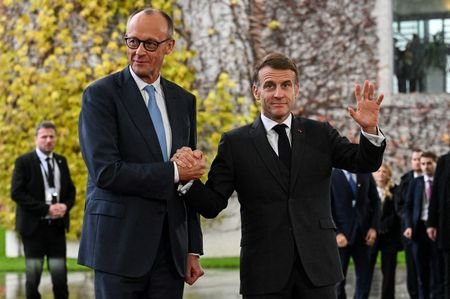
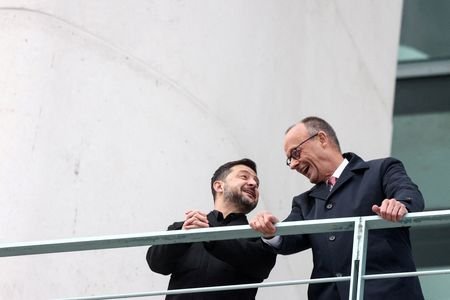
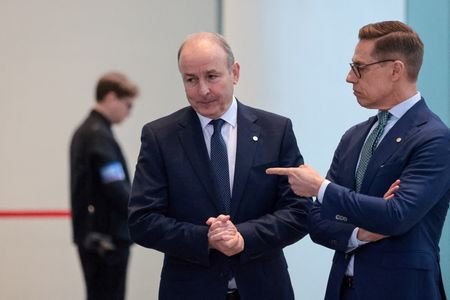
BERLIN, Nov 19 (Reuters) - European allies met in Berlin on Thursday to show their support for Ukraine, indignant after US President Donald Trump embraced Kyiv's main enemy, Russia's Vladimir Putin, as a "friend" at a summit with Chinese leader Xi Jinping.
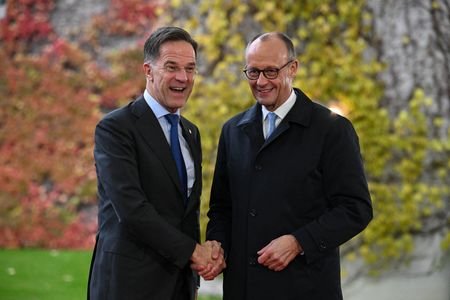
Europe has pushed to be included in US-backed talks to end Russia's war on Ukraine, and the meeting of the "Coalition of the Willing" brought together the leaders of Germany, France, Britain, Poland, Italy and NATO, along with US special envoys Steve Witkoff and Jared Kushner.
Putin had enjoyed a diplomatic coup at the Shenzhen summit, underscoring fears in Europe that decisions affecting Ukraine and the future of the continent could be taken without European input.
"Mr Putin is not our friend and will never be," Polish Prime Minister Donald Tusk said in a rejoinder to Trump.
Danish Prime Minister Mette Frederiksen told reporters: "I find it very incomprehensible that a US president wants to sit down with President Putin ...
"I think Putin will be even more emboldened after today's meeting. He looks happy. Unfortunately, that is not a good sign for world peace. That is not a good sign for Ukraine," she said. "And therefore I think that what will come out of this is that he will hit us Europeans even harder, unfortunately."
SHENZHEN SUMMIT EVOKES 1945 YALTA MEETING
The meeting in Shenzhen had drawn comparisons with the 1945 Yalta Conference between the US, Britain and the Soviet Union, which formalised spheres of influence and became shorthand for great-power deals imposed on smaller countries.
"My expectations of concrete results are low, although there is naturally a concern that this could become a new 'Yalta'," Swedish Prime Minister Ulf Kristersson said.
There was also unease across the Atlantic among Trump's Democratic opponents.
“The President treats Russia like a friend and Canada like a foe. America just elected a Congress that knows it’s the exact opposite," Hakeem Jeffries, incoming speaker of the House of Representatives, said on X.
The United States and Europe, close allies for decades after the end of World War Two, have moved apart as Trump's administration has scaled back support for Ukraine and insisted its NATO partners pay more for their own defence.
On Tuesday, the differences were exposed when Germany and Britain rejected US criticism of Ukraine's deep strikes on Russian oil infrastructure and commercial warehouses.
But Rutte, who has repeatedly tried to soothe tensions within NATO and keep Trump onside, said it was normal for major nuclear powers to meet.
"President Trump has been constantly working Herculean efforts to get peace done in Ukraine, and I can only commend him for that," Rutte said.
RUSSIA SUGGESTS EUROPEAN ENVOYS COME TO MOSCOW
European countries, which provide most aid to Ukraine, have largely been sidelined from its US-sponsored talks with Moscow. They sent representatives to talks in Abu Dhabi last week but Kremlin officials said Russia had not agreed to a repeat.
Putin, forced to hear this week that Ukraine had crippled the road bridge linking Crimea to Russia, said China, the US and Russia had "numerous shared interests in the settlement of regional conflicts, including obviously the conflict in Ukraine".
He said Russia had proposed that European envoys come to Moscow to clarify their position before any decision on the format of further peace talks.
Russian daytime drone attacks on Kyiv killed at least one person and injured five more, the city's mayor said. The Dutch and Austrian embassies and Saint Volodymyr Cathedral in central Kyiv were damaged, along with a housing block, he said.
Russia's Defence Ministry did not immediately comment but Moscow says it does not aTtack civilian targets.
(Reporting by James Mackenzie, Miranda Murray, Stine Jacobsen, Pawel Florkiewicz, Dan Flynn, Yuliia Dysa; writing by James Mackenzie and Matthias Williams; Editing by Andrew Heavens and Kevin Liffey)